P520
原文页面与交叉引用
核对英文原文页面与脚注 ↗ · 官方 PDF 212–213
P520 本导则适用于第5.2类有机过氧化物和第4.1类自反应物质只要符合第4.1.1和4.1.3节的一般规定和第4.1.7节的特殊规定,允许使用下列包装: 包装方法为OP1至OP8。第2.4.2.3.2.3和2.5.3.2.4条列出了适合于当前指定的有机过氧化物和自反应物质的包装方法。每种包装方法规定的数量每个包件允许的最大数量。允许使用下列包装: (1) 组合包装,其外包装由箱(4A、4B、4N、4C1、4C2、4D、4F、4G、4H1和 4H2)、桶(1A1、1A2、1B1、1B2、1G、1H1、1H2和1D)和罐(3A1、3A2、 3B1、3B2、3H1和3H2)组成; (2) 单一包装,由桶(1A1、1A2、1B1、1B2、1G、1H1、1H2和1D)和罐(3A1、 3A2、3B1、3B2、3H1和3H2)组成; (3) 带有塑料内包装的复合包装(6HA1、6HA2、6HB1、6HB2、6HC、6HD1、6HD2、 6HG1、6HG2、6HH1和6HH2)。 包装方法OP1至OP8的每种包装/包裹的最大装量为: 包装方法 OP1 OP21 OP3 OP41 OP5 OP6 OP7 OP8 最大装量固体和组合包装 (液体和固体)的 0.5 0.5/10 5 5/25 25 50 50 4002 最大重量(kg) 液体的最大容量3 0.5 - 5 - 30 60 60 2254 如果有两个数值,第一个数值适用于每个内包装的最大净重,第二个数值适用于整个包件的最大净重。 P520 罐为 60 kg/箱为 200 kg,对于固体,在外包装为箱(4C1、4C2、4D、4F、4G、4H1、 4H2)的组合包装中,以及在内包装为塑料或纤维且最大净重为 25kg 的组合包装中, 为400 kg。 粘性液体如不符合第1.2.1节中液体定义所规定的标准,则须作为固体处理。 罐为60L。 补充规定: 金属包装,包括组合包装的内包装和组合包装或复合包装的外包装,只能用于包装方法 OP7和OP8。 在组合包装中,玻璃容器只能用作内包装,固体的最大容量为 0.5 kg,液体的最大容量为0.5 L。 组合包装中衬垫材料不得易燃。 需贴有爆炸性副危险性标志(图例 No.1,见第 5.2.2.2.2 条)的有机过氧化物或自反应物质的包装还须符合第4.1.5.10和4.1.5.11条的规定。 特殊包装规定: PP21 对某些 B 类或 C 类自反应物质,即 UN 3221、3222、3223、3224、3231、3232、 3233 和 3234,须使用比包装方法 OP5 或 OP6 分别允许的更小容器的包装(见第 4.1.7节和第2.4.2.3.2.3条)。 PP22 UN 3241,2-溴-2-硝基丙烷-1,3-二醇,须按照包装方法OP6包装。 PP94 第2.0.4.3条中极少量的高能样品可酌情按 UN 3223 或 UN 3224 运输,但须满足以下条件:.1 仅使用由箱(4A、4B、4N、4C1、4C2、4D、4F、4G、4H1和 4H2)组成的外包装组合包装;.2 样品装在塑料、玻璃、瓷器或粗陶器制成的微量滴定板或多层滴定板中,作为内包装;.3 每个内腔的最大量对于固体不超过0.01g,对于液体不超过0.01mL;.4 每个外容器的最大净量,固体为 20g,液体为 20mL,如果是混合包装,克数和毫升数之和不超过20;以及.5 当干冰或液氮可选用作质量控制措施的冷却剂时,须符合第 5.5.3 节的规定。须提供内部支撑,以将内包装固定在其原始位置。内包装和外包装须在使用的制冷剂温度下以及在失去制冷时可能产生的温度和压力下保持其完整性。 PP95 第2.0.4.3节中少量高能样品可酌情按 UN 3223 或 3224 运输,但前提是:.1 外包装仅由 4G 型瓦楞纤维板构成,其最小尺寸为 60cm(长)×40.5cm(宽) ×30cm(高),最小壁厚为1.3cm;.2 单个物质装在最大容量为 30mL 的玻璃或塑料内容器中,置于厚度至少为 130mL、密度为18±1g/L的可膨胀聚乙烯泡沫基质中; P520.3 在泡沫载体内,内包装彼此之间至少间隔 40mm,与外包装壁之间的距离至少间隔70mm。包装件最多可容纳两层此类泡沫基质,每层最多容纳28个内包装;.4 每个内包装的最大装量,固体不超过1g,液体不超过1mL;.5 每个外包装的最大净量,固体为 56g,液体为 56mL,如果是混合包装,克数和毫升数之和不超过56;以及.6 当干冰或液氮可选用作质量控制措施的冷却剂时,须符合第 5.5.3 节的规定。须提供内部支撑,以将内包装固定在其原始位置。内包装和外包装须在使用的制冷剂温度下以及在失去制冷时可能产生的温度和压力下保持其完整性。
P520 This instruction applies to organic peroxides of class 5.2 and self-reactive substances of class 4.1. The packagings listed below are authorized provided the general provisions of 4.1.1 and 4.1.3 and special provisions of 4.1.7 are met. The packing methods are designated OP1 to OP8. The packing methods appropriate for the individual currently assigned organic peroxides and self-reactive substances are listed in 2.4.2.3.2.3 and 2.5.3.2.4. The quantities specified for each packing method are the maximum quantities authorized per package. The following packagings are authorized: (1) Combination packagings with outer packagings comprising boxes (4A, 4B, 4N, 4C1, 4C2, 4D, 4F, 4G, 4H1 and 4H2), drums (1A1, 1A2, 1B1, 1B2, 1G, 1H1, 1H2 and 1D) and jerricans (3A1, 3A2, 3B1, 3B2, 3H1 and 3H2); (2) Single packagings consisting of drums (1A1, 1A2, 1B1, 1B2, 1G, 1H1, 1H2 and 1D) and jerricans (3A1, 3A2, 3B1, 3B2, 3H1 and 3H2); (3) Composite packagings with plastics inner receptacles (6HA1, 6HA2, 6HB1, 6HB2, 6HC, 6HD1, 6HD2, 6HG1, 6HG2, 6HH1 and 6HH2). The maximum quantities per packaging/package for packing methods OP1 to OP8 are: OP1 OP21 OP3 OP41 OP5 OP6 OP7 OP8 Maximum net mass (kg) for solids and for 0.5 0.5/10 5 5/25 25 50 50 4002 combination packagings (liquid and solid) Maximum contents in litres for liquids3 0.5 – 5 – 30 60 60 2254 If two values are given, the first applies to the maximum net mass per inner packaging and the second to the maximum net mass of the complete package. 60 kg for jerricans/200 kg for boxes and, for solids, 400 kg in combination packagings with outer packagings comprising boxes (4C1, 4C2, 4D, 4F, 4G, 4H1 and 4H2) and with inner packagings of plastics or fibre with a maximum net mass of 25 kg. Viscous liquids shall be treated as solids when they do not meet the criteria provided in the definition for liquids presented in 1.2.1. 60 L for jerricans. Additional provisions: Metal packagings, including inner packagings of combination packagings and outer packagings of combination or composite packagings, may only be used for packing methods OP7 and OP8. 4 In combination packagings, glass receptacles may only be used as inner packagings with a maximum content of 0.5 kg for solids or 0.5 L for liquids. In combination packagings, cushioning materials shall not be readily combustible. The packaging of an organic peroxide or self-reactive substance required to bear an EXPLOSIVE subsidiary hazard label (Model No. 1, see 5.2.2.2.2) shall also comply with the provisions given in 4.1.5.10 and 4.1.5.11. (continued) P520 Special packing provisions: PP21 For certain self-reactive substances of types B or C, UN Nos. 3221, 3222, 3223, 3224, 3231, 3232, 3233 and 3234, a smaller packaging than that allowed by packing methods OP5 or OP6 respectively shall be used (see 4.1.7 and 2.4.2.3.2.3). PP22 UN 3241, 2-bromo-2-nitropropane-1,3-diol, shall be packed in accordance with packing method OP6. PP94 Very small amounts of energetic samples of section 2.0.4.3 may be carried under UN 3223 or UN 3224, as appropriate, provided that:.1 only combination packaging with outer packaging comprising boxes (4A, 4B, 4N, 4C1, 4C2, 4D, 4F, 4G, 4H1 and 4H2) are used;.2 the samples are carried in microtiter plates or multi-titer plates made of plastics, glass, porcelain or stoneware as inner packaging;.3 the maximum amount per individual inner cavity does not exceed 0.01 g for solids or 0.01 mL for liquids;.4 the maximum net quantity per outer packaging is 20 g for solids or 20 mL for liquids, or in the case of mixed packing the sum of grams and millilitres does not exceed 20; and.5 when dry ice or liquid nitrogen is optionally used as a coolant for quality control measures, the requirements of 5.5.3 are complied with. Interior supports shall be provided to secure the inner packagings in their original position. The inner and outer packagings shall maintain their integrity at the temperature of the refrigerant used as well as the temperatures and the pressures which could result if refrigeration were lost. PP95 Small amounts of energetic samples of section 2.0.4.3 may be carried under UN 3223 or UN 3224, as appropriate, provided that:.1 the outer packaging consist only of corrugated fibreboard of type 4G having minimum dimensions of 60 cm (length) by 40.5 cm (width) by 30 cm (height) and minimum wall thickness of 1.3 cm;.2 the individual substance is contained in an inner packaging of glass or plastics of maximum capacity mL placed in an expandable polyethylene foam matrix of at least 130 mm thickness having a density of 18 1 g/L; ±.3 within the foam carrier, inner packagings are segregated from each other by a minimum distance of 40 mm and from the wall of the outer packaging by a minimum distance of 70 mm. The package may contain up to two layers of such foam matrices, each carrying up to 28 inner packagings;.4 the maximum content of each inner packaging does not exceed 1 g for solids or 1 mL for liquids;.5 the maximum net quantity per outer packaging is 56 g for solids or 56 mL for liquids, or in the case of mixed packing the sum of grams and millilitres does not exceed 56; and.6 when dry ice or liquid nitrogen is optionally used as a coolant for quality control measures, the requirements of 5.5.3 are complied with. Interior supports shall be provided to secure the inner packagings in their original position. The inner and outer packagings shall maintain their integrity at the temperature of the refrigerant used as well as the temperatures and the pressures which could result if refrigeration were lost.
IBC520
原文页面与交叉引用
核对英文原文页面与脚注 ↗ · 官方 PDF 233–235
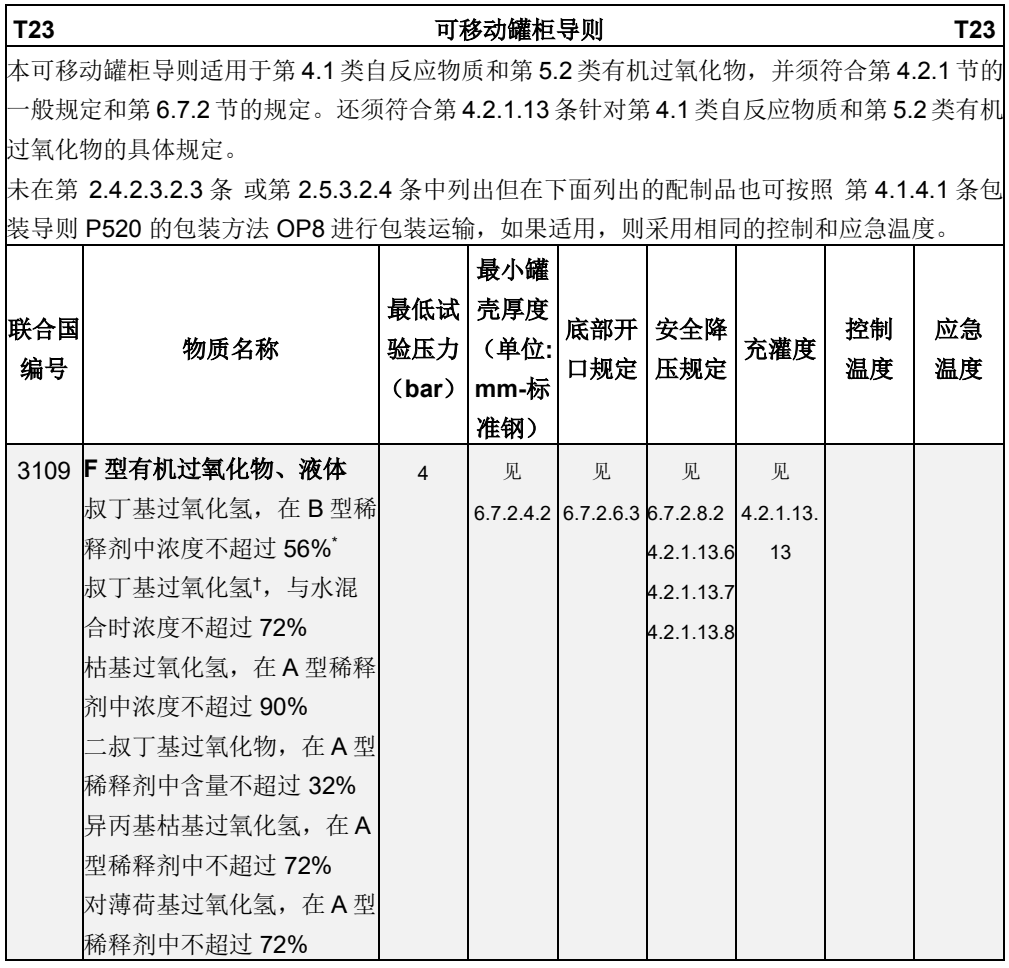
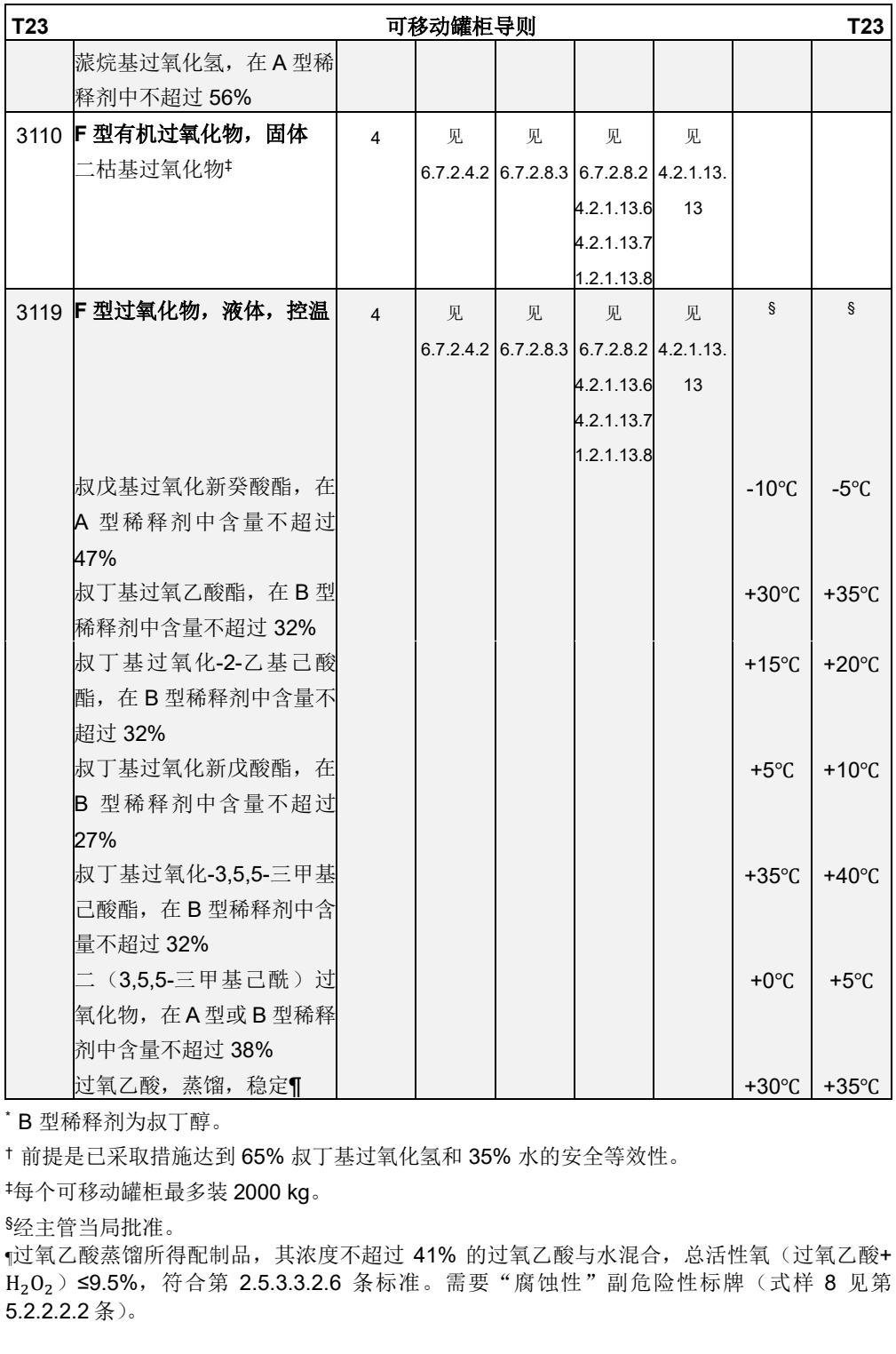
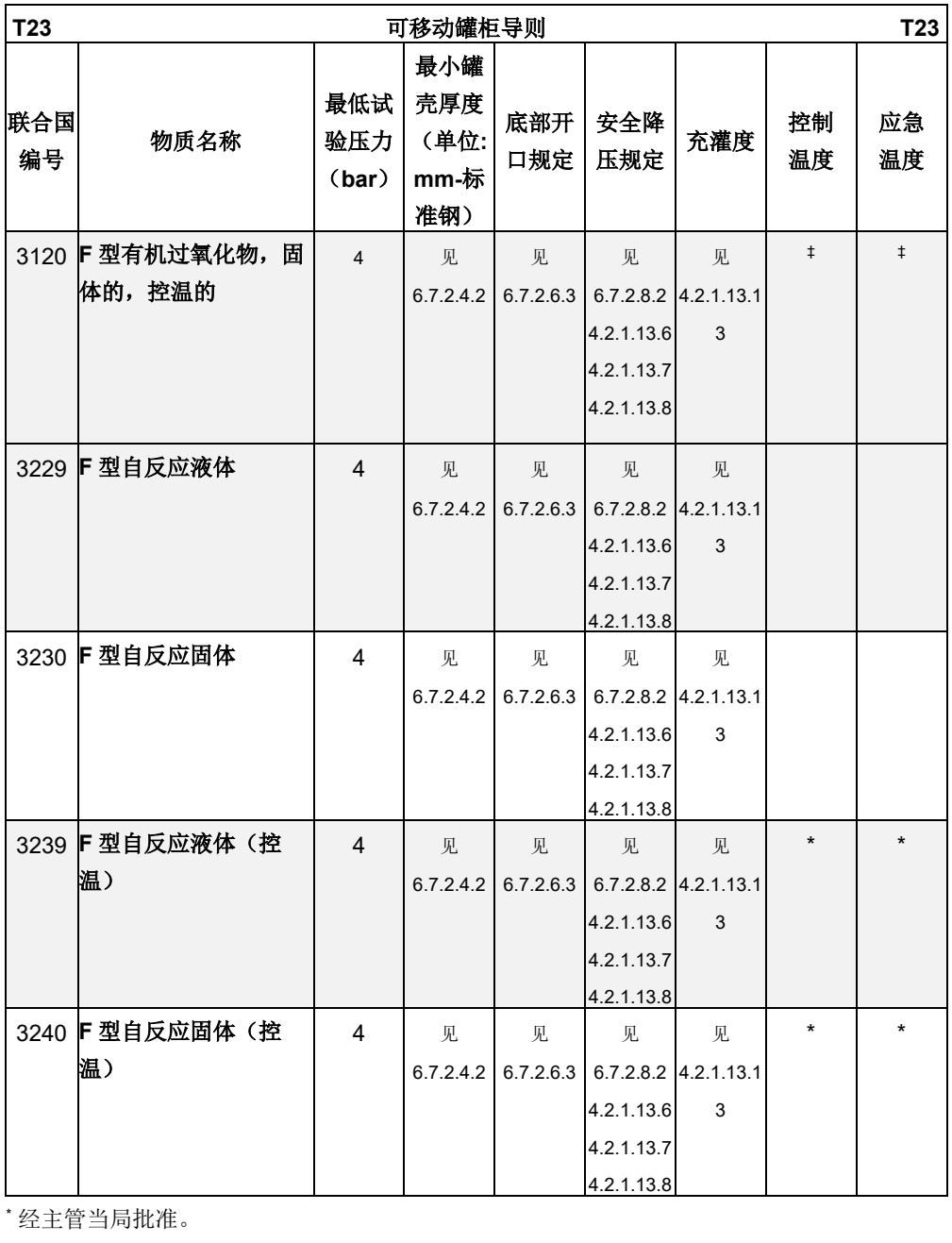
IBC520 本导则适用于F型有机过氧化物和自反应物质。 只要符合第4.1.1、4.1.2和4.1.3节的一般规定和第4.1.7.2条的特别规定,允许下列IBCs适用于所列配制品。未在第2.4.2.3.2.3 或 2.5.3.2.4条中列出但在下面列出的配制品,也可以按照第4.1.4.1条包装导则P520 的包装方法 OP8 进行包装运输,并采用相同的控制和应急温度 (如适用)。 对于以下未列出的配制品,只能使用经主管当局批准的IBCs(见第4.1.7.2.2条)。 联合有机过氧化物 IBC 最大控制应急国编类型量(L) 温度温度号 3109 F型有机过氧化物、液体的叔丁基枯基过氧化氢 31HA1 1000 叔丁基过氧化氢、含水不超过72% 31A 1250 31HA1 1000 过氧乙酸叔丁酯,在A型稀释剂中浓度不超过 31A 1250 32% 31HA1 1000 过氧苯甲酸叔丁酯,在A型稀释剂中浓度不超 31A 1250 过32% 过氧-3,5,5-三甲基己酸叔丁酯、在 A型稀释剂 31A 1250 中浓度不超过37% 31HA1 1000 枯基过氧化氢、在 A 型稀释剂中浓度不超过 31HA1 1250 90% 过氧化二苯甲酰、浓度不超过 42%,稳定分 31A 1250 散在水中二叔丁基过氧化物、在A型稀释剂中浓度不超 31A 1250 过52% 31HA1 1000 1,1-二-(叔丁基过氧)环乙烷、在A型稀释剂 31A 1250 中浓度不超过37% 1,1-二-(叔丁基过氧)环己烷、在A型稀释剂 31H1 1000 中浓度不超过42% 过氧化二月桂酰、浓度不超过 42%,稳定分 31HA1 1000 散在水中 IBC520 2,5-二甲基-2,5-二(叔丁基过氧)己烷,在 A 31HA1 1,000 型稀释剂中不超过52%。 异丙基枯基过氧化氢、在 A 型稀释剂中浓度不 31HA1 1250 超过72% 对孟基过氧化氢、在A型稀释剂中浓度不超过 31HA1 1250 72% 过氧乙酸、稳定的、浓度不超过17% 31H1 1500 31HA1 1500 31A 1500 31H2 1500 3,6,9-三乙基-3,6,9-三甲基-1,4,7-三过氧化 31HA1 1000 物,在A型稀释剂中浓度不超过27%。 3110 F型有机过氧化物,固体的二枯基过氧化物 31A 2000 31H1 31HA1 3119 F型有机过氧化物,液体的,控温过氧化-2-乙基己酸叔戊酯,在 A 型稀释剂中 31A 1000 +15℃ +20℃ 浓度不超过62%。 过氧化叔戊酸叔戊脂,在A类稀释剂中,浓度 31A 1250 +10℃ +15℃ 不超过32% 过氧新戊酸叔戊酯,浓度不超过 42%,在水 31HA1 1,000 0°C +10°C 中稳定分散过氧2-乙基己酸叔丁酯,在B类稀释剂中,浓 31HA1 1000 +30℃ +35℃ 度不超过32% 31A 1250 +30℃ +35℃ 过氧化新癸酸叔丁酯,在A类稀释剂中,浓度 31A 1250 0℃ +10℃ 不超过32% 过氧化新癸酸叔丁酯,浓度不超过 42%,在 31A 1250 -5℃ +5℃ 水中稳定分散过氧化新癸酸叔丁酯,浓度不超过 52%,在 31A 1250 -5℃ +5℃ 水中稳定分散过氧化叔戊酸叔丁脂,在B类稀释剂中,浓度 31HA1 1000 +10℃ +15℃ 不超过27% 31A 1250 10℃ +15℃ 过氧新戊酸叔丁酯,在 A 型稀释剂中不超过 31HA1 1,000 +10°C +15°C 42% 31A 1,250 +10°C +15°C IBC520 双-(2-新癸酰基过氧化异丙基)苯,浓度不 31A 1250 -15℃ -5℃ 超过42%,在水中稳定分散过氧化新癸酸(3-羟基-1,1-二甲基)丁酯,浓 31A 1250 -15℃ -5℃ 度不超过52%,在水中稳定分散过氧化新癸酸异丙苯酯,浓度不超过 52%, 31A 1250 -15℃ -5℃ 在水中稳定分散过氧化重碳酸-双-(4-叔丁基环已酯),浓度不 31HA1 1000 +30℃ +35℃ 超过42%,在水中稳定分散过氧化重碳酸-联十六烷酯,浓度不超过 31HA1 1000 +30℃ +35℃ 42%,在水中稳定分散过氧化重碳酸-双环已酯,浓度不超过 42%, 31A 1250 +10℃ +15℃ 在水中稳定分散过氧化重碳酸-双-(2-乙基已酯),浓度不超过 31A 1250 -20℃ -10℃ 62%,在水中稳定分散 31HA1 1000 -20℃ -10℃ 过氧重碳酸-双十四烷酯,浓度不超过 42%, 31HA1 1000 +15℃ +20℃ 在水中稳定分散过氧化-双-(3,5,5-三甲基已酰),在 A 类稀释 31HA1 1000 +10℃ +15℃ 剂中,浓度不超过52% 31A 1250 +10℃ +15℃ 过氧化-双-(3,5,5-三甲基己酰),浓度不超过 31HA13 1000 +10℃ +15℃+ 52%,在水中稳定分散 1A 1250 +10℃ 15℃ 过氧化(二)异丁酰,不超过 28%,在水中 31HA1 1000 -20℃ -10℃ 稳定分散 31A 1250 -20℃ -10℃ 过氧化(二)异丁酰,不超过 42%,在水中 31HA1 1000 -25℃ -15℃ 稳定分散 31A 1250 -25℃ -15℃ 1,1,3,3-四甲基苯过氧化-2-乙酸乙酯,在A类 31HA1 1000 +15℃ +20℃ 稀释剂中,浓度不超过67% 过氧化新癸酸-1,1,3,3-四甲基丁脂,浓度不超 31A 1250 -5℃ +5℃ 过52%,在水中稳定分散 31HA1 1000 -5℃ +5℃ 3120 F型有机过氧化物,固体的,控温的补充规定: IBCs须配备通气装置以允许运输期间蒸气的排放。 减压装置的入口须位于运输期间IBCs在最大盛装量条件下的蒸气空间内。 为防止金属 IBCs 或带有完整金属外壳的复合 IBCs 炸裂,应急减压装置须设计为排出自行加速分解过程中或按按第4.2.1.13.8条中的公式计算的不少于1小时的火焰吞没期间产生的所有分解产物和蒸气。本包装导则中规定的控制温度和应急温度基于非隔热型IBCs。根据本导则在IBCs中托运有机过氧化物时,托运人有责任确保: IBC520 (a) 中型散装容器中安装的压力释放装置和应急减压装置的设计应充分考虑到有机过氧化物的自行加速分解和火焰吞没因素;以及 (b) 当适用时,所示的控制温度和应急温度是适当的,同时考虑到所用IBCs的设计要求(例如绝热性)。
IBC520 This instruction applies to organic peroxides and self-reactive substances of type F. The IBCs listed below are authorized for the formulations listed, provided the general provisions of 4.1.1, 4.1.2 and 4.1.3 and special provisions of 4.1.7.2 are met. The formulations not listed in 2.4.2.3.2.3 or 2.5.3.2.4 but listed below may also be transported packed in accordance with packing method OP8 of packing instruction P520 of 4.1.4.1, with the same control and emergency temperatures, if applicable. For formulations not listed below, only IBCs which are approved by the competent authority may be used (see 4.1.7.2.2). Maximum Control Emergency UN Type of Organic peroxide quantity temper- temper- No. IBC (litres) ature ature 3109 ORGANIC PEROXIDE TYPE F, LIQUID tert-Butyl cumyl peroxide 31HA1 1,000 tert-Butyl hydroperoxide, not more than 72% with water 31A 1,250 31HA1 1,000 tert-Butyl peroxyacetate, not more than 32% in diluent type A 31A 1,250 31HA1 1,000 tert-Butyl peroxybenzoate, not more than 32% in diluent type A 31A 1,250 tert-Butyl peroxy-3,5,5-trimethylhexanoate, not more than 37% 31A 1,250 in diluent type A 31HA1 1,000 Cumyl hydroperoxide, not more than 90% in diluent type A 31HA1 1,250 Dibenzoyl peroxide, not more than 42% as a stable dispersion 31H1 1,000 Di-tert-butyl peroxide, not more than 52% in diluent type A 31A 1,250 31HA1 1,000 1,1-Di-(tert-butylperoxy)cyclohexane, not more than 37% in 31A 1,250 diluent type A 1,1-Di-(tert-butylperoxy)cyclohexane, not more than 42% in 31H1 1,000 diluent type A Dilauroyl peroxide, not more than 42%, stable dispersion, in 31HA1 1,000 water 2,5-Dimethyl-2,5-di(tert-butylperoxy)hexane, not more than 31HA1 1,000 52% in diluent type A Isopropylcumyl hydroperoxide, not more than 72% in diluent 31HA1 1,250 type A p-Menthyl hydroperoxide, not more than 72% in diluent type A 31HA1 1,250 Peroxyacetic acid, stabilized, not more than 17% 31H1 1,500 31H2 1,500 31HA1 1,500 31A 1,500 3,6,9-Triethyl-3,6,9-trimethyl-1,4,7-triperoxonane, not more than 31HA1 1,000 27% in diluent type A (continued) IBC520 Maximum Control Emergency UN Type of Organic peroxide quantity temper- temper- No. IBC (litres) ature ature 3110 ORGANIC PEROXIDE TYPE F, SOLID Dicumyl peroxide 31A 2,000 31H1 31HA1 3119 ORGANIC PEROXIDE TYPE F, LIQUID, TEMPERATURE CONTROLLED tert-Amyl peroxy-2-ethylhexanoate, not more than 62% in 31HA1 1,000 15C 20C + ° + ° diluent type A tert-Amyl peroxypivalate, not more than 32% in diluent type A 31A 1,250 10C 15C + ° + ° tert-Amyl peroxypivalate, not more than 42%, stable 31HA1 1,000 0C 10C ° + ° dispersion, in water tert-Butyl peroxy-2-ethylhexanoate, not more than 32% in 31HA1 1,000 30C 35C + ° + ° diluent type B 31A 1,250 30C 35C + ° + ° tert-Butyl peroxyneodecanoate, not more than 32% in diluent 31A 1,250 0C 10C ° + ° type A tert-Butyl peroxyneodecanoate, not more than 42%, stable 31A 1,250 5C 5C - ° + ° dispersion, in water tert-Butyl peroxyneodecanoate, not more than 52%, stable 31A 1,250 5C 5C - ° + ° dispersion, in water tert-Butyl peroxypivalate, not more than 27% in diluent type B 31HA1 1,000 10C 15C + ° + ° 31A 1,250 10C 15C + ° + ° tert-Butyl peroxypivalate, not more than 42% in diluent type A 31HA1 1,000 10C 15C + ° + ° 31A 1,250 10C 15C + ° + ° Di-(2-neodecanoylperoxyisopropyl)benzene, not more than 31A 1,250 15C 5C - ° - ° 42%, stable dispersion, in water 3-Hydroxy-1,1-dimethylbutyl peroxy neodecanoate, not more 31A 1,250 15C 5C - ° - ° than 52%, stable dispersion, in water 4 Cumyl peroxyneodecanoate, not more than 52%, stable 31A 1,250 15C 5C - ° - ° dispersion, in water Di-(4-tert-butylcyclohexyl) peroxydicarbonate, not more than 31HA1 1,000 30C 35C + ° + ° 42%, stable dispersion, in water Dicetyl peroxydicarbonate, not more than 42%, stable 31HA1 1,000 30C 35C + ° + ° dispersion, in water Dicyclohexyl peroxydicarbonate, not more than 42% as 31A 1,250 10C 15C + ° + ° a stable dispersion, in water Di-(2-ethylhexyl) peroxydicarbonate, not more than 62%, stable 31A 1,250 20C 10C - ° - ° dispersion, in water 31HA1 1,000 20C 10C - ° - ° Dimyristyl peroxydicarbonate, not more than 42%, stable 31HA1 1,000 15C 20C + ° + ° dispersion, in water Di-(3,5,5-trimethylhexanoyl) peroxide, not more than 52% in 31HA1 1,000 10C 15C + ° + ° diluent type A 31A 1,250 10C 15C + ° + ° △ Di-(3,5,5-trimethylhexanoyl) peroxide, not more than 52%, 31HA1 1,000 + 10 ° C + 15 ° C stable dispersion, in water 31A 1,250 10C 15C + ° + ° Diisobutyryl peroxide, not more than 28%, stable dispersion, 31HA1 1,000 20C 10C - ° - ° in water 31A 1,250 20C 10C - ° - ° Diisobutyryl peroxide, not more than 42%, stable dispersion, 31HA1 1,000 25C 15C - ° - ° in water 31A 1,250 25C 15C - ° - ° 1,1,3,3-Tetramethylbutyl peroxy-2-ethylhexanoate, not more 31HA1 1,000 15C 20C + ° + ° than 67%, in diluent type A 1,1,3,3-Tetramethylbutyl peroxyneodecanoate, not more than 31A 1,250 5C 5C - ° + ° 52%, stable dispersion, in water 31HA1 1,000 5C 5C - ° + ° 3120 ORGANIC PEROXIDE, TYPE F, SOLID, TEMPERATURE CONTROLLED Additional provisions: IBCs shall be provided with a device to allow venting during transport. The inlet to the pressure relief device shall be sited in the vapour space of the IBC under maximum filling conditions during transport. To prevent explosive rupture of metal IBCs or composite IBCs with complete metal casing, the emergency relief devices shall be designed to vent all the decomposition products and vapours evolved during self-accelerating decomposition or during a period of not less than one hour of fire-engulfment as calculated by the formula in 4.2.1.13.8. The control and emergency temperatures specified in this packing instruction are based on a non-insulated IBC. When consigning an organic peroxide in an IBC in accordance with this instruction, it is the responsibility of the consignor to ensure that: (a) the pressure and emergency relief devices installed on the IBC are designed to take appropriate account of the self-accelerating decomposition of the organic peroxide and of fire engulfment; and (b) when applicable, the control and emergency temperatures indicated are appropriate, taking into account the design (such as insulation) of the IBC to be used.
 5.2