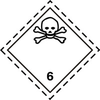
HYDROGEN CYANIDE, STABILIZED, containing less than 3% water and absorbed in a porous inert material
Class
6.1
Subsidiary risk / reference
Not listed
Packing group
I
Marine pollutant entry
P
Limited quantities
0
Excepted quantities
E0
Packing instruction
P099
Special provisions
386
Special packing provision
Not listed
IBC instruction
Not listed
IBC special provisions
Not listed
Portable tank / bulk container codes
Not listed
Tank special provisions
Not listed
EmS
F-A, S-U
Stowage and handling
Category D SW1 SW2 Category D SW1 SW2
Segregation
Not listed in this DGL field
Properties and observations · source text
Very volatile, colourless liquid, evolving extremely toxic flammable vapours, absorbed in a porous inert material. Miscible with water. Highly toxic if swallowed, by skin contact or by inhalation.
P099 Only packagings which are approved for these goods by the competent authority may be used (see 4.1.3.7). A copy of the competent authority approval shall accompany each consignment or the transport document shall include an indication that the packaging was approved by the competent authority.
When substances are stabilized by temperature control, the provisions of 7.3.7 apply. When chemical stabilization is employed, the person offering the packaging, IBC or tank for transport shall ensure that the level of stabilization is sufficient to prevent the substance in the packaging, IBC or tank from dangerous polymerization at a bulk mean temperature of 50°C, or, in the case of a portable tank, 45°C. Where chemical stabilization becomes ineffective at lower temperatures within the anticipated duration of transport, temperature control is required. In making this determination factors to be taken into consideration include, but are not limited to, the capacity and geometry of the packaging, IBC or tank and the effect of any insulation present, the temperature of the substance when offered for transport, the duration of the journey and the ambient temperature conditions typically encountered in the journey (considering also the season of year), the effectiveness and other properties of the stabilizer employed, applicable operational controls imposed by regulation (e.g. requirements to protect from sources of heat, including other cargo transported at a temperature above ambient) and any other relevant factors.