IMDG Code 42-24 · Dangerous Goods List

Open interactive lookup ↗

UN2023EPICHLOROHYDRIN

English proper shipping name · Check the cargo and applicable provisions before shipment.

Class6.1
Packing groupII
EmSF-E, S-D

Dangerous Goods List entries

The comparison below lists all entries. Expanded provisions and the label preview on this page apply to Entry 1.

Compare all 1 DGL entry

Entry 1 · Packing group II

EPICHLOROHYDRIN

Class
6.1
Subsidiary risk / reference
3
Packing group
II
Marine pollutant entry
P
Limited quantities
100 mL
Excepted quantities
E4
Packing instruction
P001
Special provisions
279
Special packing provision
Not listed
IBC instruction
IBC02
IBC special provisions
Not listed
Portable tank / bulk container codes
T7
Tank special provisions
TP2 TP13
EmS
F-E, S-D
Stowage and handling
Category A SW2 Category A SW2
Segregation
Not listed in this DGL field
Properties and observations · source text
Colourless flammable liquid with a chloroform-like odour. Flashpoint: approximately 32 C c.c. Toxic if swallowed, by skin ° contact or by inhalation.

Packing and large packaging instructions

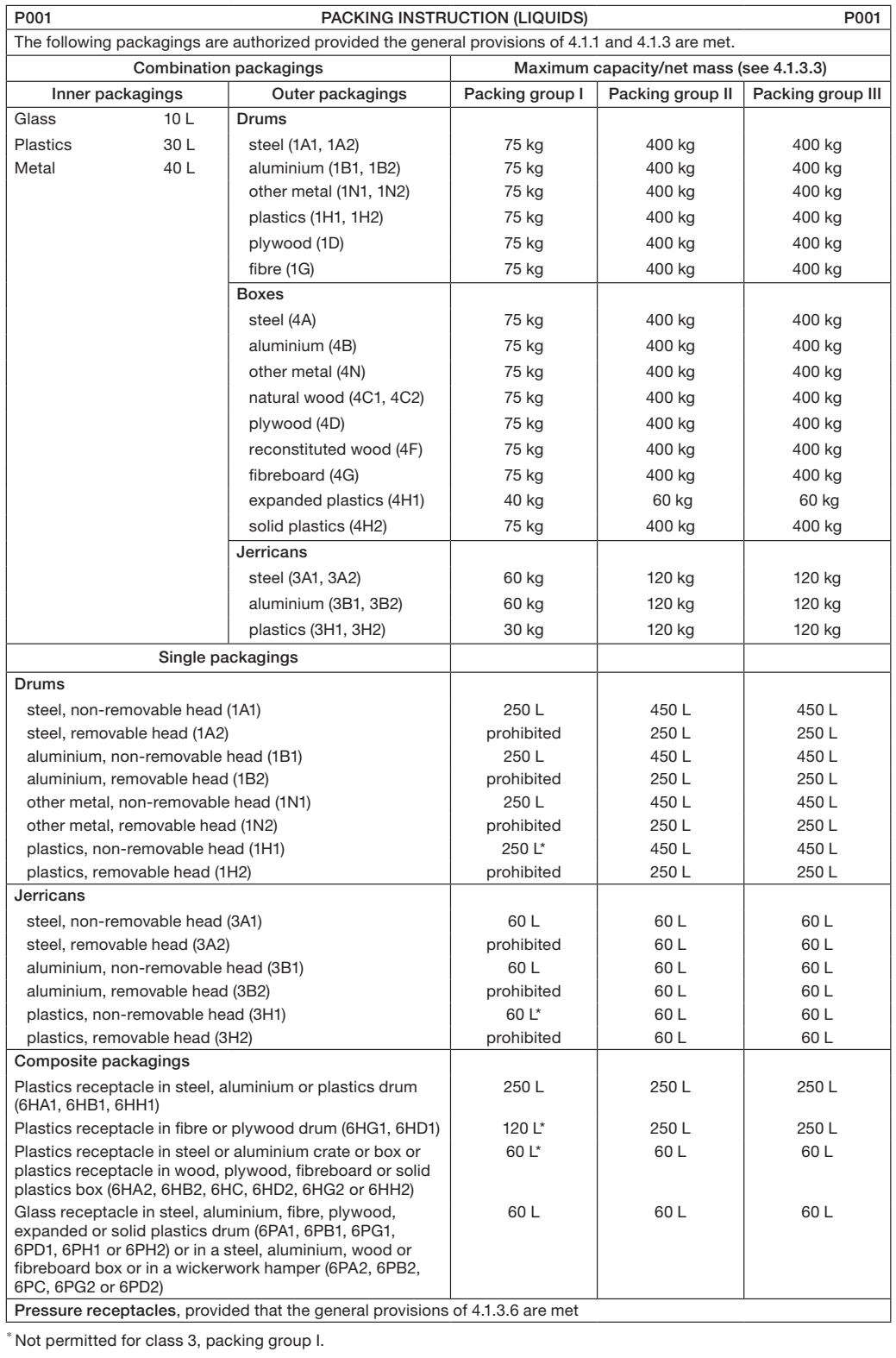
P001

Source pages and references

Check original English pages and footnotes ↗ · official PDF 166–167

Original table and continuation pages. Read the applicable packing group, footnotes and assigned special provisions together. Open an image to zoom.

P001 · English · PDF 170
P001 · 42-24 · PDF 170 · 1/2
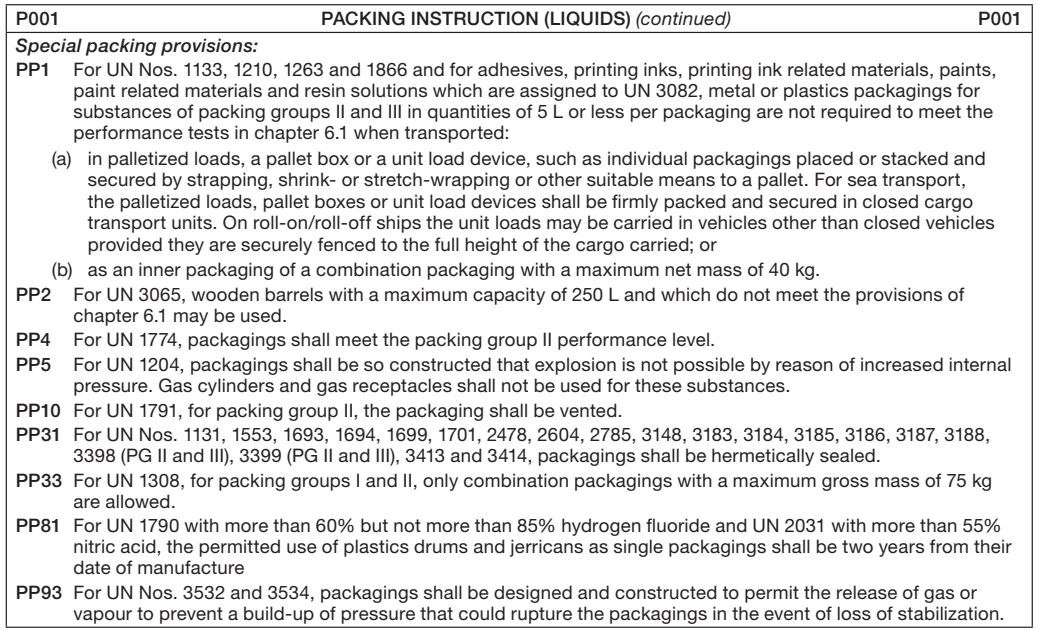
P001 · English · PDF 171
P001 · 42-24 · PDF 171 · 2/2
Extracted source text
(LIQUIDS) P001 The following packagings are authorized provided the general provisions of 4.1.1 and 4.1.3 are met. Combination packagings Maximum capacity/net mass (see 4.1.3.3) Glass 10 L Drums Plastics 30 L steel (1A1, 1A2) 75 kg 400 kg 400 kg Metal 40 L aluminium (1B1, 1B2) 75 kg 400 kg 400 kg other metal (1N1, 1N2) 75 kg 400 kg 400 kg plastics (1H1, 1H2) 75 kg 400 kg 400 kg plywood (1D) 75 kg 400 kg 400 kg fibre (1G) 75 kg 400 kg 400 kg Boxes steel (4A) 75 kg 400 kg 400 kg aluminium (4B) 75 kg 400 kg 400 kg other metal (4N) 75 kg 400 kg 400 kg natural wood (4C1, 4C2) 75 kg 400 kg 400 kg plywood (4D) 75 kg 400 kg 400 kg reconstituted wood (4F) 75 kg 400 kg 400 kg fibreboard (4G) 75 kg 400 kg 400 kg expanded plastics (4H1) 40 kg 60 kg 60 kg solid plastics (4H2) 75 kg 400 kg 400 kg Jerricans steel (3A1, 3A2) 60 kg 120 kg 120 kg aluminium (3B1, 3B2) 60 kg 120 kg 120 kg plastics (3H1, 3H2) 30 kg 120 kg 120 kg 4 Single packagings Drums steel, non-removable head (1A1) 250 L 450 L 450 L steel, removable head (1A2) prohibited 250 L 250 L aluminium, non-removable head (1B1) 250 L 450 L 450 L aluminium, removable head (1B2) prohibited 250 L 250 L other metal, non-removable head (1N1) 250 L 450 L 450 L other metal, removable head (1N2) prohibited 250 L 250 L plastics, non-removable head (1H1) 250 L* 450 L 450 L plastics, removable head (1H2) prohibited 250 L 250 L Jerricans steel, non-removable head (3A1) 60 L 60 L 60 L steel, removable head (3A2) prohibited 60 L 60 L aluminium, non-removable head (3B1) 60 L 60 L 60 L aluminium, removable head (3B2) prohibited 60 L 60 L plastics, non-removable head (3H1) 60 L* 60 L 60 L plastics, removable head (3H2) prohibited 60 L 60 L Composite packagings Plastics receptacle in steel, aluminium or plastics drum 250 L 250 L 250 L (6HA1, 6HB1, 6HH1) Plastics receptacle in fibre or plywood drum (6HG1, 6HD1) 120 L* 250 L 250 L Plastics receptacle in steel or aluminium crate or box or 60 L* 60 L 60 L plastics receptacle in wood, plywood, fibreboard or solid plastics box (6HA2, 6HB2, 6HC, 6HD2, 6HG2 or 6HH2) Glass receptacle in steel, aluminium, fibre, plywood, 60 L 60 L 60 L expanded or solid plastics drum (6PA1, 6PB1, 6PG1, 6PD1, 6PH1 or 6PH2) or in a steel, aluminium, wood or fibreboard box or in a wickerwork hamper (6PA2, 6PB2, 6PC, 6PG2 or 6PD2) Pressure receptacles, provided that the general provisions of 4.1.3.6 are met * Not permitted for class 3, packing group I. (LIQUIDS) (continued) P001 Special packing provisions: PP1 For UN Nos. 1133, 1210, 1263 and 1866 and for adhesives, printing inks, printing ink related materials, paints, paint related materials and resin solutions which are assigned to UN 3082, metal or plastics packagings for substances of packing groups II and III in quantities of 5 L or less per packaging are not required to meet the performance tests in chapter 6.1 when transported: (a) in palletized loads, a pallet box or a unit load device, such as individual packagings placed or stacked and secured by strapping, shrink- or stretch-wrapping or other suitable means to a pallet. For sea transport, the palletized loads, pallet boxes or unit load devices shall be firmly packed and secured in closed cargo transport units. On roll-on/roll-off ships the unit loads may be carried in vehicles other than closed vehicles provided they are securely fenced to the full height of the cargo carried; or (b) as an inner packaging of a combination packaging with a maximum net mass of 40 kg. PP2 For UN 3065, wooden barrels with a maximum capacity of 250 L and which do not meet the provisions of chapter 6.1 may be used. PP4 For UN 1774, packagings shall meet the packing group II performance level. PP5 For UN 1204, packagings shall be so constructed that explosion is not possible by reason of increased internal pressure. Gas cylinders and gas receptacles shall not be used for these substances. PP10 For UN 1791, for packing group II, the packaging shall be vented. PP31 For UN Nos. 1131, 1553, 1693, 1694, 1699, 1701, 2478, 2604, 2785, 3148, 3183, 3184, 3185, 3186, 3187, 3188, 3398 (PG II and III), 3399 (PG II and III), 3413 and 3414, packagings shall be hermetically sealed. PP33 For UN 1308, for packing groups I and II, only combination packagings with a maximum gross mass of 75 kg are allowed. PP81 For UN 1790 with more than 60% but not more than 85% hydrogen fluoride and UN 2031 with more than 55% nitric acid, the permitted use of plastics drums and jerricans as single packagings shall be two years from their date of manufacture PP93 For UN Nos. 3532 and 3534, packagings shall be designed and constructed to permit the release of gas or vapour to prevent a build-up of pressure that could rupture the packagings in the event of loss of stabilization.

IMDG Code 42-24 · English source text
IBC instructions

IBC02

Source pages and references

Check original English pages and footnotes ↗ · official PDF 231–231

IBC02 The following IBCs are authorized, provided the general provisions of 4.1.1, 4.1.2 and 4.1.3 are met: Metal (31A, 31B and 31N); Rigid plastics (31H1 and 31H2); Composite (31HZ1). Special packing provisions: B5 For UN Nos. 1791, 2014, 2984 and 3149, IBCs shall be provided with a device to allow venting during transport. The inlet to the venting device shall be sited in the vapour space of the IBC under maximum filling conditions during transport. B8 The pure form of this substance shall not be transported in IBCs since it is known to have a vapour pressure of more than 110 kPa at 50C or 130 kPa at 55C. ° ° B15 For UN 2031 with more than 55% nitric acid, the permitted use of rigid plastics IBCs and of rigid plastics inner receptacles of composite IBCs shall be two years from their date of manufacture. B16 For UN 3375, IBCs of type 31A and 31N are not allowed without competent authority approval. B20 For UN Nos. 1716, 1717, 1736, 1737, 1738, 1742, 1743, 1755, 1764, 1768, 1776, 1778, 1782, 1789, 1790, 1796, 1826, 1830, 1832, 2031, 2308, 2353, 2513, 2584, 2796 and 2817 coming under PG II, IBCs shall be fitted with two shut-off devices.

IMDG Code 42-24 · English source text
Portable tank instructions

T7

Source pages and references

Check original English pages and footnotes ↗ · official PDF 260–267

These portable tank instructions apply to liquid and solid substances of class 1 and classes 3 to 9. The general provisions of section 4.2.1 and the requirements of section 6.7.2 shall be met. The instructions for portable tanks with FRP shells apply to substances of classes or divisions 1, 3, 5.1, 6.1, 6.2, 8 and 9. Additionally, the provisions of chapter 6.10 apply to the portable tanks with FRP shells.

T7 · Selected instruction · IMDG 42-24
Portable tank instructionMinimum test pressure (bar)Minimum shell thickness (in mm – reference steel) (see 6.7.2.4)Pressure relief provisionsa (see 6.7.2.8)Bottom opening provisionsb (see 6.7.2.6)
T74See 6.7.2.4.2NormalSee 6.7.2.6.3

a When the word “Normal” is indicated, all the provisions of 6.7.2.8 apply except for 6.7.2.8.3. b When this column indicates “not allowed”, bottom openings are not permitted when the substance to be transported is a liquid (see 6.7.2.6.1). When the substance to be transported is a solid at all temperatures encountered under normal conditions of transport, bottom openings conforming to the provisions of 6.7.2.6.2 are authorized.

Source PDF pages:264 · 42-24

Extracted source text
S T1 – T22 These portable tank instructions apply to liquid and solid substances of class 1 and classes 3 to 9. The general provisions of section 4.2.1 and the requirements of section 6.7.2 shall be met. The instructions for portable tanks with FRP shells apply to substances of classes or divisions 1, 3, 5.1, 6.1, 6.2, 8 and 9. Additionally, the provisions of chapter 6.10 apply to the portable tanks with FRP shells. Minimum shell thickness Pressure relief Bottom opening (in mm – reference provisionsa provisionsb instruction pressure (bar) steel) (see 6.7.2.8) (see 6.7.2.6) (see 6.7.2.4) 4 See 6.7.2.4.2 Normal See 6.7.2.6.3

IMDG Code 42-24 · English source text
Tank special provisions

TP13

Source pages and references

Check original English pages and footnotes ↗ · official PDF 268–268

Self-contained breathing apparatus shall be provided when this substance is transported, unless no self-contained breathing apparatus, as required by SOLAS regulation II-2/19 (II-2/54), is on board.

IMDG Code 42-24 · English source text
Special provisions

SP 279

Source pages and references

Check original English pages and footnotes ↗ · official PDF 761–761

The substance is assigned to this classification or packing group based on human experience rather than the strict application of classification criteria set out in this Code.

IMDG Code 42-24 · English source text

Stowage and handling codes

Labels and marks

Reference preview for Entry 1 · Packing group II. Confirm the cargo classification and any conditions in the special provisions.

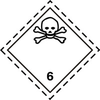
Toxic substance 6.1
Toxic substance 6.1
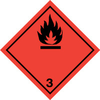
Flammable liquid 3
Flammable liquid 3
Marine pollutant mark

This UN may be carried as a limited quantity (Code allocation 100 mL); if this consignment is shipped as LQ, the LQ mark must be applied and chapter 3.4 complied with

This UN may be carried as an excepted quantity (code E4); if this consignment is shipped as EQ, the EQ mark must be applied and chapter 3.5 complied with

Explore this class