P203 This instruction applies to class 2 refrigerated liquefied gases. Requirements for closed cryogenic receptacles: (1) The general requirements of 4.1.6.1 shall be met. (2) The requirements of chapter 6.2 shall be met. (3) The closed cryogenic receptacles shall be so insulated that they do not become coated with frost. (4) Test pressure Refrigerated liquids shall be filled in closed cryogenic receptacles with the following minimum test pressures: (a) For closed cryogenic receptacles with vacuum insulation, the test pressure shall not be less than 1.3 times the sum of the maximum internal pressure of the filled receptacle, including during filling and discharge, plus kPa (1 bar); (b) For other closed cryogenic receptacles, the test pressure shall be not less than 1.3 times the maximum internal pressure of the filled receptacle, taking into account the pressure developed during filling and discharge. (5) Filling For non-flammable, non-toxic refrigerated liquefied gases the volume of liquid phase at the filling temperature and at a pressure of 100 kPa (1 bar) shall not exceed 98% of the water capacity of the pressure receptacle. For flammable refrigerated liquefied gases the gas filled into the receptacle shall remain below the level at which, if the contents were raised to the temperature at which the vapour pressure equalled the opening pressure of the relief valve, the volume of the liquid phase would reach 98% of the water capacity at that temperature. (6) Pressure-relief devices Closed cryogenic receptacles shall be fitted with at least one pressure-relief device. (7) Compatibility Materials used to ensure the leakproofness of the joints or for the maintenance of the closures shall be compatible with the contents. In the case of receptacles intended for the transport of oxidizing gases (i.e. with a subsidiary hazard of 5.1), these materials shall not react with these gases in a dangerous manner. (8) Periodic inspection The periodic inspection and test frequencies of pressure relief valves in accordance with 6.2.1.6.3 shall not exceed five years. Requirements for open cryogenic receptacles: Only the following non-oxidizing refrigerated liquefied gases of class 2.2 may be transported in open cryogenic △ 4 receptacles: UN Nos. 1913, 1951, 1963, 1970, 1977, 2591, 3136 and 3158. For these gases, when used as a coolant, the requirements of 5.5.3 shall apply. Open cryogenic receptacles shall be constructed to meet the following requirements: (1) The receptacles shall be designed, manufactured, tested and equipped in such a way as to withstand all conditions, including fatigue, to which they will be subjected during their normal use and during normal conditions of transport. (2) The capacity shall be not more than 450 L. (3) The receptacle shall have a double wall construction with the space between the inner and outer wall being evacuated (vacuum insulation). The insulation shall prevent the formation of hoar frost on the exterior of the receptacle. (4) The materials of construction shall have suitable mechanical properties at the service temperature. (5) Materials which are in direct contact with the dangerous goods shall not be affected or weakened by the dangerous goods intended to be transported and shall not cause a dangerous effect, e.g. catalysing a reaction or reacting with the dangerous goods. (6) Receptacles of glass double wall construction shall have an outer packaging with suitable cushioning or absorbent materials which withstand the pressures and impacts liable to occur under normal conditions of transport. (7) The receptacle shall be designed to remain in an upright position during transport, e.g. have a base whose smaller horizontal dimension is greater than the height of the centre of gravity when filled to capacity or be mounted on gimbals. (8) The openings of the receptacles shall be fitted with devices allowing gases to escape, preventing any splashing out of liquid, and so configured that they remain in place during transport. (9) Open cryogenic receptacles shall bear the following marks permanently affixed, e.g. by stamping, engraving or etching: (a) The manufacturer’s name and address; (b) The model number or name; (c) The serial or batch number; (d) The UN number and proper shipping name of gases for which the receptacle is intended; (e) The capacity of the receptacle in litres.
This portable tank instruction applies to refrigerated liquefied gases. The general provisions of 4.2.3 and 6.7.4 shall be met.
T75 does not specify a universal test pressure or filling percentage. Confirm the gas, tank design and approval, temperature range and holding time for the intended journey. Read the complete filling conditions and exceptions below.
Referenced filling and operating requirements
4.2.3.6.1
Prior to filling, the shipper shall ensure that the portable tank is approved for the refrigerated liquefied gas to be transported and that the portable tank is not loaded with refrigerated liquefied gases which, in contact with the materials of the shell, gaskets and service equipment, are likely to react dangerously with them to form dangerous products or appreciably weaken these materials. During filling, the temperature of the refrigerated liquefied gas shall be within the limits of the design temperature range.
PDF 261
4.2.3.6.2
In estimating the initial quantity of gas filled into the shell, the necessary holding time for the intended journey, including any delays which might be encountered, shall be taken into consideration. The initial quantity of gas filled into the shell, except as provided for in 4.2.3.6.3 and 4.2.3.6.4, shall be such that if the contents, except helium, were to be raised to a temperature at which the vapour pressure is equal to the maximum allowable working pressure (MAWP) the volume occupied by liquid would not exceed 98%.
PDF 261
4.2.3.6.3
Shells intended for the transport of helium can be filled up to but not above the inlet of the pressure-relief device.
PDF 261
4.2.3.6.4
A higher initial quantity of gas filled into the shell may be allowed, subject to approval by the competent authority, when the intended duration of transport is considerably shorter than the holding time.
PDF 261
4.2.3.6.5
Portable tanks shall not be filled or discharged while they remain on board.
PDF 261
4.2.3.7.1
The actual holding time shall be calculated for each journey in accordance with a procedure recognized by the competent authority, on the basis of the following: .1 the reference holding time for the refrigerated liquefied gas to be transported (see 6.7.4.2.8.1) (as indicated on the plate referred to in 6.7.4.15.1); .2 the actual filling density; .3 the actual filling pressure; .4 the lowest set pressure of the pressure-limiting device(s).
PDF 261
4.2.3.7.2
The actual holding time shall be marked either on the portable tank itself or on a metal plate firmly secured to the portable tank, in accordance with 6.7.4.15.2.
PDF 261
4.2.3.7.3
The date at which the actual holding time ends shall be entered in the transport document (see 5.4.1.5.19).
PDF 261
Original instruction, tables and continuation pages
Original pages are preserved as supplied. The readable display follows the verified English numerical values and references and, for T50, the December 2025 corrigendum. The original pages may therefore show superseded wording or source discrepancies.
T75 · 42-24 · PDF 271 · 1/1
IMDG 42-24 · Source PDF pages:271 · Checked 2026-10-22
Extracted source text
T75 This portable tank instruction applies to refrigerated liquefied gases. The general provisions of 4.2.3 and 6.7.4 shall be met.
For the purposes of documentation and package marking, the proper shipping name shall be supplemented with the technical name (see 3.1.2.8.1). For UN 3077 and UN 3082 only, the technical name may be a name shown in capital letters in column 2 of the Dangerous Goods List, provided that this name does not include “N.O.S.” and that special provision 274 is not assigned. The name which most appropriately describes the substance or mixture shall be used, e.g.: UN 3082, ENVIRONMENTALLY HAZARDOUS SUBSTANCE, LIQUID, N.O.S. (PAINT) UN 3082, ENVIRONMENTALLY HAZARDOUS SUBSTANCE, LIQUID, N.O.S. (PERFUMERY PRODUCTS).
IMDG Code 42-24 · English source text
Labels and marks
Reference preview for Entry 1. Confirm the cargo classification and any conditions in the special provisions.
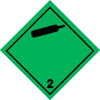
Non-toxic non-flamm. gas 2.2
⚠ The marine pollutant (MP) status must be determined from the actual consignment: this is a generic N.O.S. entry, and no "P" in column 4 of the Index does not exclude applicability (2.10.2.4). Per 2.10.2.5, if the consignment meets the marine pollutant criteria of 2.9.3 it must be carried as a marine pollutant with the MP mark.
This UN may be carried as a limited quantity (Code allocation 120 mL); if this consignment is shipped as LQ, the LQ mark must be applied and chapter 3.4 complied with
This UN may be carried as an excepted quantity (code E1); if this consignment is shipped as EQ, the EQ mark must be applied and chapter 3.5 complied with