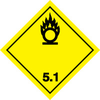
Entry 1
OXYGEN GENERATOR, CHEMICAL
- Class
- 5.1
- Subsidiary risk / reference
- Not listed
- Packing group
- Not assigned in this entry
- Marine pollutant entry
- Not listed; check the cargo classification
- Limited quantities
- 0
- Excepted quantities
- E0
- Packing instruction
- P500
- Special provisions
- 284
- Special packing provision
- Not listed
- IBC instruction
- Not listed
- IBC special provisions
- Not listed
- Portable tank / bulk container codes
- Not listed
- Tank special provisions
- Not listed
- EmS
- F-H, S-Q
- Stowage and handling
- Category D Category D
- Segregation
- Not listed in this DGL field
Properties and observations · source text
Oxygen generators, chemical are devices containing chemicals which, upon activation, release oxygen as a product of chemical reaction. Chemical oxygen generators are used for the generation of oxygen for respiratory support, e.g. in aircraft, submarines, spacecraft, bomb shelters and breathing apparatus. Oxidizing salts such as chlorates and perchlorates of lithium, sodium and potassium, which are used in chemical oxygen generators, evolve oxygen when heated. These salts are mixed (compounded) with a fuel, usually iron powder, to form a chlorate candle, which produces oxygen by continuous reaction. The fuel is used to generate heat by oxidation. Once the reaction begins, oxygen is released from the hot salt by thermal decomposition (a thermal shield is used around the generator). A portion of the oxygen reacts with the fuel to produce more heat, which produces more oxygen, and so on. Initiation of the reaction can be achieved by a percussion device, friction device or electric wire.