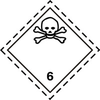
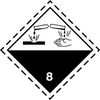
Colourless to yellow liquids with a pungent odour. Immiscible with water. React violently with water or steam, evolving hydrogen chloride, an irritating and corrosive gas apparent as white fumes. When involved in a fire, evolve toxic gas. In the presence of moisture, highly corrosive to most metals. Toxic if swallowed, by skin contact or by inhalation. Cause burns to skin, eyes and mucous membranes.
P010 The following packagings are authorized, provided that the general provisions of 4.1.1 and 4.1.3 are met. Combination packagings Maximum net mass (see 4.1.3.3) Glass 1 L Drums Steel 40 L steel (1A1, 1A2) 400 kg plastics (1H1, 1H2) 400 kg plywood (1D) 400 kg fibre (1G) 400 kg Boxes steel (4A) 400 kg natural wood (4C1, 4C2) 400 kg plywood (4D) 400 kg reconstituted wood (4F) 400 kg fibreboard (4G) 400 kg expanded plastics (4H1) 60 kg solid plastics (4H2) 400 kg Single packagings Maximum capacity (see 4.1.3.3) Drums steel, non-removable head (1A1) 450 L Jerricans steel, non-removable head (3A1) 60 L Composite packagings plastics receptacle in steel drums (6HA1) 250 L Steel pressure receptacles provided that the general provisions of 4.1.3.6 are met.
These portable tank instructions apply to liquid and solid substances of class 1 and classes 3 to 9. The general provisions of section 4.2.1 and the requirements of section 6.7.2 shall be met. The instructions for portable tanks with FRP shells apply to substances of classes or divisions 1, 3, 5.1, 6.1, 6.2, 8 and 9. Additionally, the provisions of chapter 6.10 apply to the portable tanks with FRP shells.
T14 · Selected instruction · IMDG 42-24
Portable tank instruction
Minimum test pressure (bar)
Minimum shell thickness (in mm – reference steel) (see 6.7.2.4)
Pressure relief provisionsa (see 6.7.2.8)
Bottom opening provisionsb (see 6.7.2.6)
T14
6
6 mm
See 6.7.2.8.3
Not allowed
a When the word “Normal” is indicated, all the provisions of 6.7.2.8 apply except for 6.7.2.8.3.
b When this column indicates “not allowed”, bottom openings are not permitted when the substance to be transported
is a liquid (see 6.7.2.6.1). When the substance to be transported is a solid at all temperatures encountered under normal
conditions of transport, bottom openings conforming to the provisions of 6.7.2.6.2 are authorized.
Source PDF pages:264 · 42-24
Extracted source text
S T1 – T22 These portable tank instructions apply to liquid and solid substances of class 1 and classes 3 to 9. The general provisions of section 4.2.1 and the requirements of section 6.7.2 shall be met. The instructions for portable tanks with FRP shells apply to substances of classes or divisions 1, 3, 5.1, 6.1, 6.2, 8 and 9. Additionally, the provisions of chapter 6.10 apply to the portable tanks with FRP shells. Minimum shell thickness Pressure relief Bottom opening (in mm – reference provisionsa provisionsb instruction pressure (bar) steel) (see 6.7.2.8) (see 6.7.2.6) (see 6.7.2.4) 6 6 mm See 6.7.2.8.3 Not allowed
Self-contained breathing apparatus shall be provided when this substance is transported, unless no self-contained breathing apparatus, as required by SOLAS regulation II-2/19 (II-2/54), is on board.
A portable tank having a minimum test pressure of 4 bar may be used if it is shown that a test pressure of 4 bar or less is acceptable according to the test pressure definition in 6.7.2.1.
For the purposes of documentation and package marking, the proper shipping name shall be supplemented with the technical name (see 3.1.2.8.1). For UN 3077 and UN 3082 only, the technical name may be a name shown in capital letters in column 2 of the Dangerous Goods List, provided that this name does not include “N.O.S.” and that special provision 274 is not assigned. The name which most appropriately describes the substance or mixture shall be used, e.g.: UN 3082, ENVIRONMENTALLY HAZARDOUS SUBSTANCE, LIQUID, N.O.S. (PAINT) UN 3082, ENVIRONMENTALLY HAZARDOUS SUBSTANCE, LIQUID, N.O.S. (PERFUMERY PRODUCTS).
Reference preview for Entry 1 · Packing group II. Confirm the cargo classification and any conditions in the special provisions.
Toxic substance 6.1Corrosive 8
⚠ The marine pollutant (MP) status must be determined from the actual consignment: this is a generic N.O.S. entry, and no "P" in column 4 of the Index does not exclude applicability (2.10.2.4). Per 2.10.2.5, if the consignment meets the marine pollutant criteria of 2.9.3 it must be carried as a marine pollutant with the MP mark.