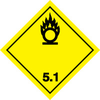
Non-sensitized emulsions, suspensions and gels consisting primarily of a mixture of ammonium nitrate and fuel, intended to produce a Type E blasting explosive only after further processing prior to use. Substances shall satisfactorily pass test series 8 of the Manual of Tests and Criteria, part I, section 18 and be approved by the competent authority.
P505 This instruction applies to UN 3375. The following packagings are authorized, provided that the general provisions of 4.1.1 and 4.1.3 are met. △ Combination packagings Maximum capacity/ Glass 5 L Boxes Plastics 5 L aluminium (4B) 125 kg Metal 5 L natural wood, ordinary (4C1) 125 kg natural wood, sift-proof walls (4C2) 125 kg plywood (4D) 125 kg fibreboard (4G) 125 kg plastics, solid (4H2) 125 kg Drums aluminium, removable head (1B2) 125 kg fibre (1G) 125 kg other metal, removable head (1N2) 125 kg plastics, removable head (1H2) 125 kg plywood (1D) 125 kg Jerricans aluminium, removable head (3B2) 125 kg plastics, removable head (3H2) 125 kg Single packagings Drums aluminium (1B1, 1B2) 250 L plastics (1H1, 1H2) 250 L Jerricans aluminium (3B1, 3B2), 60 L plastics (3H1, 3H2) 60 L Composite packagings plastics receptacle with outer aluminium drum (6HB1) 250 L plastics receptacle with outer fibre, plastics or plywood drum 250 L (6HG1, 6HH1, 6HD1) plastics receptacle with outer aluminium crate or box or plastics receptacle with 60 L outer wooden, plywood, fibreboard or solid plastics box (6HB2, 6HC, 6HD2, 6HG2, 6HH2) glass receptacle with outer aluminium, fibre or plywood drum (6PB1, 6PG1, 6PD1) 60 L or with outer expanded plastics or solid plastics receptacles (6PH1, 6PH2) or with outer aluminium crate or box or with outer wooden or fibreboard box or with outer wickerwork hamper (6PB2, 6PC, 6PG2, 6PD2)
IBC02 The following IBCs are authorized, provided the general provisions of 4.1.1, 4.1.2 and 4.1.3 are met: Metal (31A, 31B and 31N); Rigid plastics (31H1 and 31H2); Composite (31HZ1). Special packing provisions: B5 For UN Nos. 1791, 2014, 2984 and 3149, IBCs shall be provided with a device to allow venting during transport. The inlet to the venting device shall be sited in the vapour space of the IBC under maximum filling conditions during transport. B8 The pure form of this substance shall not be transported in IBCs since it is known to have a vapour pressure of more than 110 kPa at 50C or 130 kPa at 55C. ° ° B15 For UN 2031 with more than 55% nitric acid, the permitted use of rigid plastics IBCs and of rigid plastics inner receptacles of composite IBCs shall be two years from their date of manufacture. B16 For UN 3375, IBCs of type 31A and 31N are not allowed without competent authority approval. B20 For UN Nos. 1716, 1717, 1736, 1737, 1738, 1742, 1743, 1755, 1764, 1768, 1776, 1778, 1782, 1789, 1790, 1796, 1826, 1830, 1832, 2031, 2308, 2353, 2513, 2584, 2796 and 2817 coming under PG II, IBCs shall be fitted with two shut-off devices.
These portable tank instructions apply to liquid and solid substances of class 1 and classes 3 to 9. The general provisions of section 4.2.1 and the requirements of section 6.7.2 shall be met. The instructions for portable tanks with FRP shells apply to substances of classes or divisions 1, 3, 5.1, 6.1, 6.2, 8 and 9. Additionally, the provisions of chapter 6.10 apply to the portable tanks with FRP shells.
T1 · Selected instruction · IMDG 42-24
Portable tank instruction
Minimum test pressure (bar)
Minimum shell thickness (in mm – reference steel) (see 6.7.2.4)
Pressure relief provisionsa (see 6.7.2.8)
Bottom opening provisionsb (see 6.7.2.6)
T1
1.5
See 6.7.2.4.2
Normal
See 6.7.2.6.2
a When the word “Normal” is indicated, all the provisions of 6.7.2.8 apply except for 6.7.2.8.3.
b When this column indicates “not allowed”, bottom openings are not permitted when the substance to be transported
is a liquid (see 6.7.2.6.1). When the substance to be transported is a solid at all temperatures encountered under normal
conditions of transport, bottom openings conforming to the provisions of 6.7.2.6.2 are authorized.
Source PDF pages:264 · 42-24
Extracted source text
S T1 – T22 These portable tank instructions apply to liquid and solid substances of class 1 and classes 3 to 9. The general provisions of section 4.2.1 and the requirements of section 6.7.2 shall be met. The instructions for portable tanks with FRP shells apply to substances of classes or divisions 1, 3, 5.1, 6.1, 6.2, 8 and 9. Additionally, the provisions of chapter 6.10 apply to the portable tanks with FRP shells. Minimum shell thickness Pressure relief Bottom opening (in mm – reference provisionsa provisionsb instruction pressure (bar) steel) (see 6.7.2.8) (see 6.7.2.6) (see 6.7.2.4) 1.5 See 6.7.2.4.2 Normal See 6.7.2.6.2
For UN Nos. 0331, 0332 and 3375, portable tanks may be used subject to the following conditions:.1 To avoid unnecessary confinement, each portable tank constructed of metal or fibre-reinforced plastics shall be fitted with a pressure relief device that may be of the re-closing spring-loaded type, a frangible disc or a fusible element. The set-to-discharge or burst pressure, as applicable, shall not be greater than 2.65 bar for portable tanks with minimum test pressures greater than bar..2 F or UN 3375 only, suitability for transport in tanks shall be demonstrated. One method to evaluate this suitability is test 8 (d) in Test Series 8 (see Manual of Tests and Criteria, part 1, subsection 18.7)..3 Substances shall not be allowed to remain in the portable tank for any period that could result in caking. Appropriate measures shall be taken to avoid accumulation and packing of substances in the tank (e.g. cleaning, etc).
This entry applies to non-sensitized emulsions, suspensions and gels consisting primarily of a mixture of ammonium nitrate and fuel, intended to produce a Type E blasting explosive only after further processing prior to use. The mixture for emulsions typically has the following composition: 60–85% ammonium nitrate, 5–30% water, 2–8% fuel, 0.5–4% emulsifier agent, 0–10% soluble flame suppressants, and trace additives. Other inorganic nitrate salts may replace part of the ammonium nitrate. The mixture for suspensions and gels typically has the following composition: 60–85% ammonium nitrate, 0–5% sodium or potassium perchlorate, 0–17% hexamine nitrate or monomethylamine nitrate, 5–30% water, 2–15% fuel, 0.5–4% thickening agent, 0–10% soluble flame suppressants, and trace additives. Other inorganic nitrate salts may replace part of the ammonium nitrate. Substances shall satisfy the criteria for classification as an ammonium nitrate emulsion, suspension or gel, intermediate for blasting explosives (ANE) of Test Series 8 of the Manual of Tests and Criteria, part I, section 18 and be approved by the competent authority.
Reference preview for Entry 1 · Packing group II. Confirm the cargo classification and any conditions in the special provisions.
Oxidizer 5.1
This UN may be carried as an excepted quantity (code E2); if this consignment is shipped as EQ, the EQ mark must be applied and chapter 3.5 complied with