P206 This instruction applies to UN Nos. 3500, 3501, 3502, 3503, 3504 and 3505. Unless otherwise indicated in these provisions, cylinders and pressure drums conforming to the applicable requirements of Chapter 6.2 are authorized. (1) The general packing requirements of 4.1.6.1 shall be met. (2) The maximum test period for periodic inspection shall be 5 years. (3) Cylinders and pressure drums shall be so filled that at 50C the non-gaseous phase does not exceed 95% of ° their water capacity and they are not completely filled at 60C. When filled, the internal pressure at 65C shall not ° ° exceed the test pressure of the cylinders and pressure drums. The vapour pressures and volumetric expansion of all substances in the cylinders and pressure drums shall be taken into account. For liquids charged with a compressed gas both components – the liquid and the compressed gas – have to be taken into consideration in the calculation of the internal pressure in the pressure receptacle. When experimental data is not available, the following steps shall be carried out: (a) calculation of the vapour pressure of the liquid and of the partial pressure of the compressed gas at 15°C (filling temperature); (b) calculation of the volumetric expansion of the liquid phase resulting from the heating from 15°C to 65°C and calculation of the remaining volume for the gaseous phase; (c) calculation of the partial pressure of the compressed gas at 65°C considering the volumetric expansion of the liquid phase; Note: The compressibility factor of the compressed gas at 15°C and 65°C shall be considered. (d) calculation of the vapour pressure of the liquid at 65°C; (e) the total pressure is the sum of the vapour pressure of the liquid and the partial pressure of the compressed gas at 65°C; (f) consideration of the solubility of the compressed gas at 65°C in the liquid phase. The test pressure of the cylinders or pressure drums shall not be less than the calculated total pressure minus kPa (1bar). If the solubility of the compressed gas in the liquid phase is not known for the calculation, the test pressure can be calculated without taking the gas solubility (subparagraph (f)) into account. (4) The minimum test pressure shall be in accordance with P200 for the propellant but shall not be less than 20 bar. Additional requirement: Cylinders and pressure drums shall not be offered for transport when connected with spray application equipment such as a hose and wand assembly. Special packing provisions: PP89 F or UN Nos. 3501, 3502, 3503, 3504 and 3505, notwithstanding 4.1.6.1.9.2, non-refillable cylinders used may have a water capacity in L not exceeding 1 000L divided by the test pressure expressed in bars provided capacity and pressure restrictions of the construction standard comply with clause 1 of ISO 11118:2015 Amd 1:2019, which limits the maximum capacity to 50L. + PP97 For fire-extinguishing agents assigned to UN 3500 the maximum test period for periodic inspection shall be years. They may be transported in tubes of a maximum water capacity of 450 L conforming to the applicable requirements of chapter 6.2.
F or UN Nos. 3501, 3502, 3503, 3504 and 3505, notwithstanding 4.1.6.1.9.2, non-refillable cylinders used may have a water capacity in L not exceeding 1 000L divided by the test pressure expressed in bars provided capacity and pressure restrictions of the construction standard comply with clause 1 of ISO 11118:2015 Amd 1:2019, which limits the maximum capacity to 50L. +
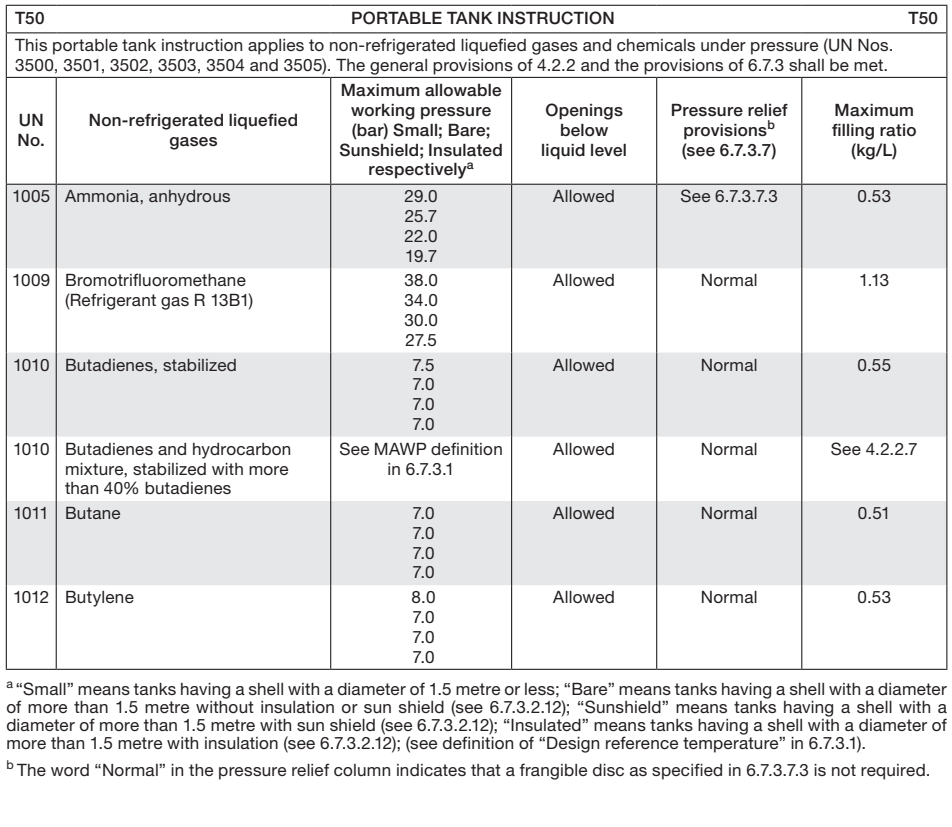
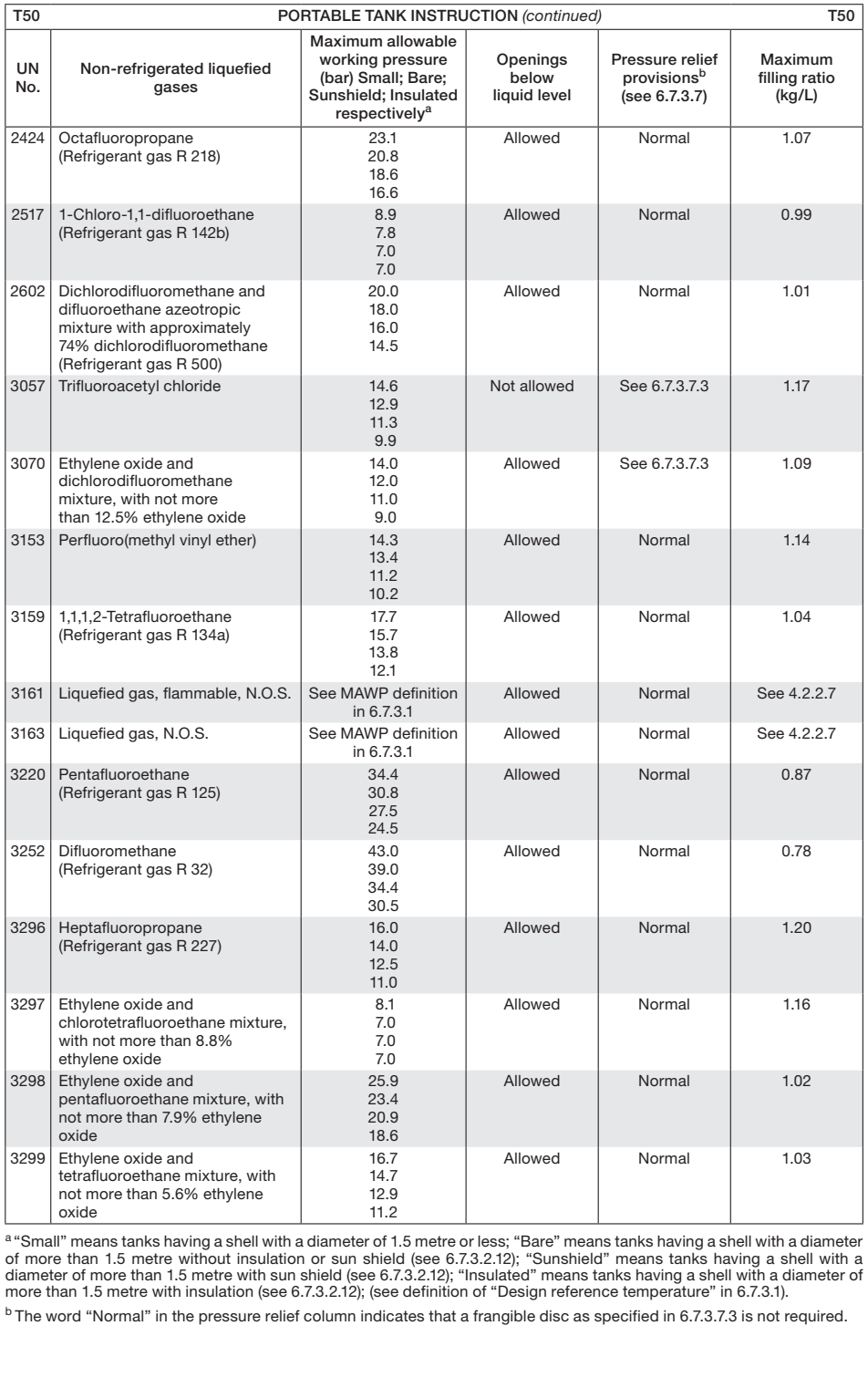
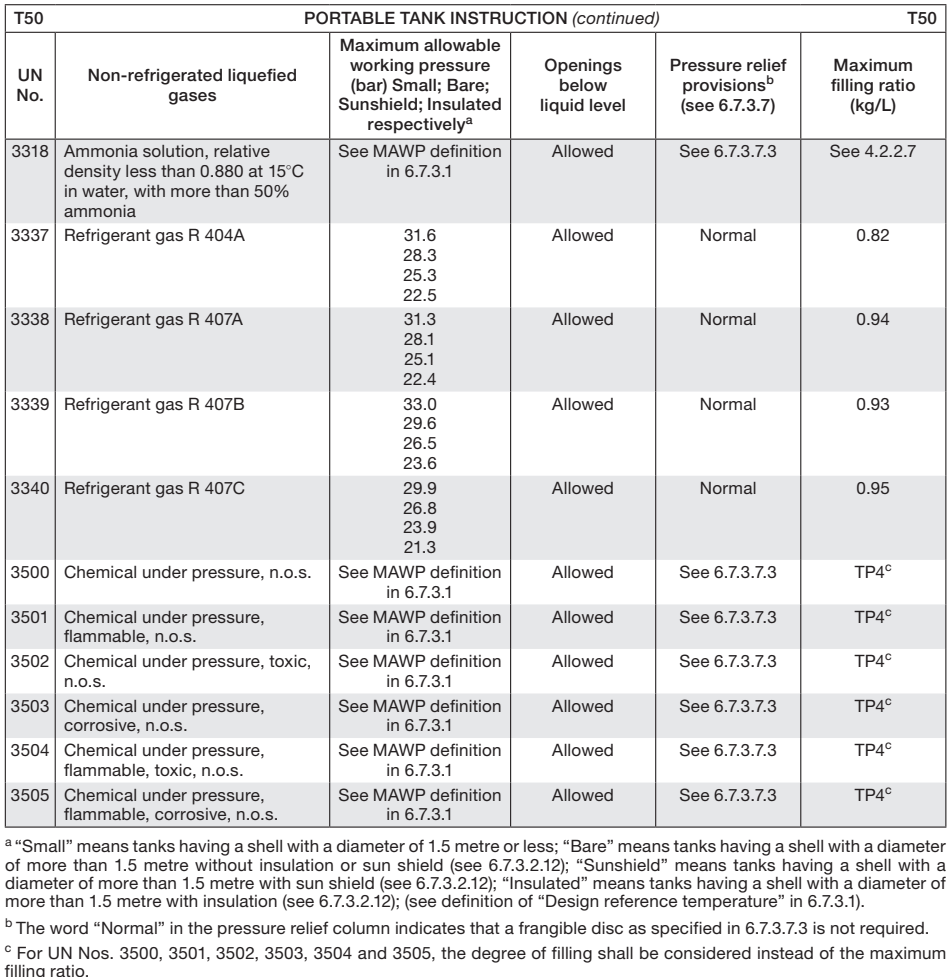
This portable tank instruction applies to non-refrigerated liquefied gases and chemicals under pressure (UN Nos. 3500, 3501, 3502, 3503, 3504 and 3505). The general provisions of 4.2.2 and the provisions of 6.7.3 shall be met.
Showing all source rows for UN3503. Match the exact gas or formulation and the assigned TP provisions. A UN number alone does not establish suitability of the tank or approval of the consignment.
The maximum filling ratio heading follows the December 2025 IMO corrigendum: “kg/L” is removed. A reference such as 4.2.2.7 or TP4 is not a numerical filling ratio. IMO corrigendum
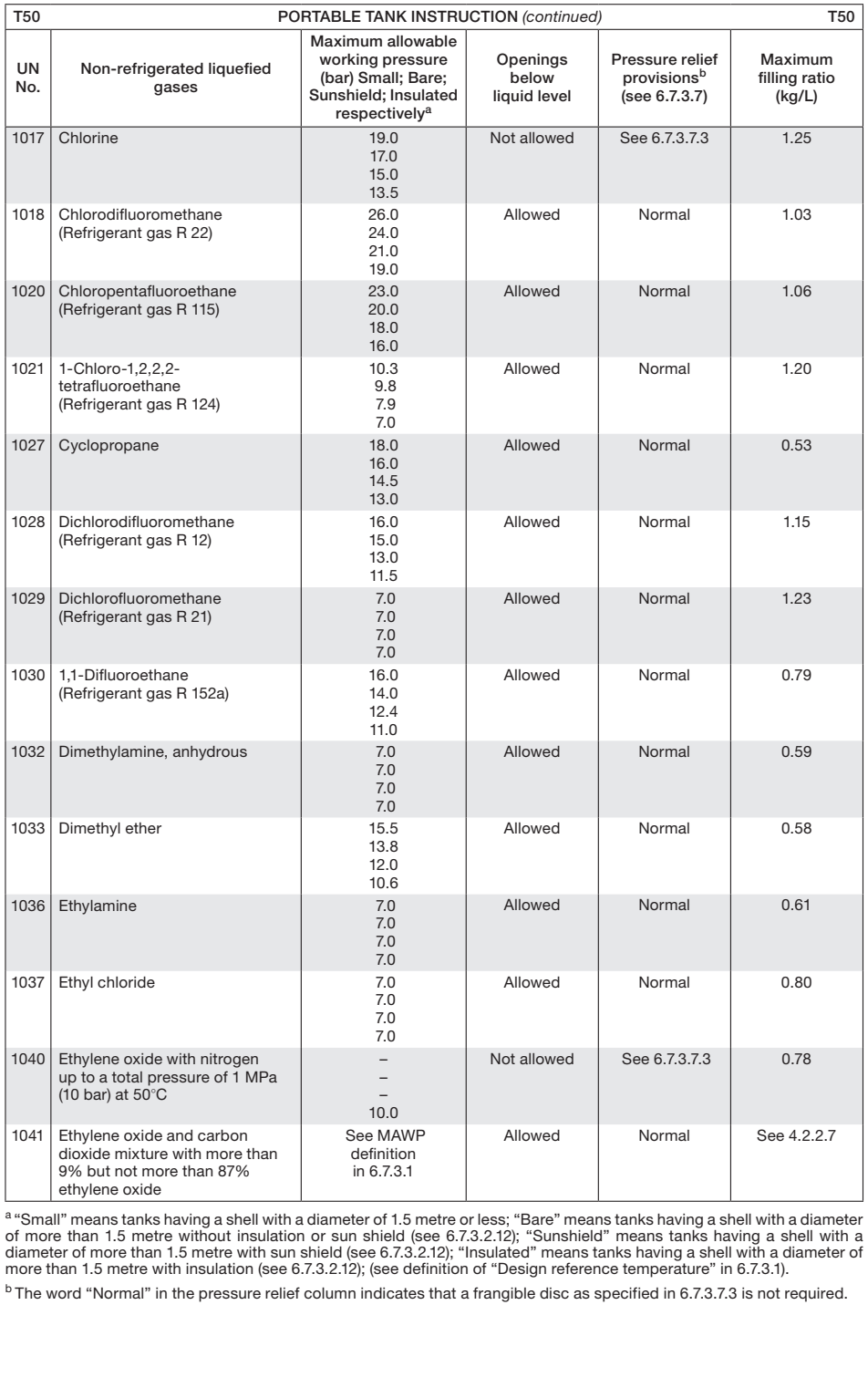
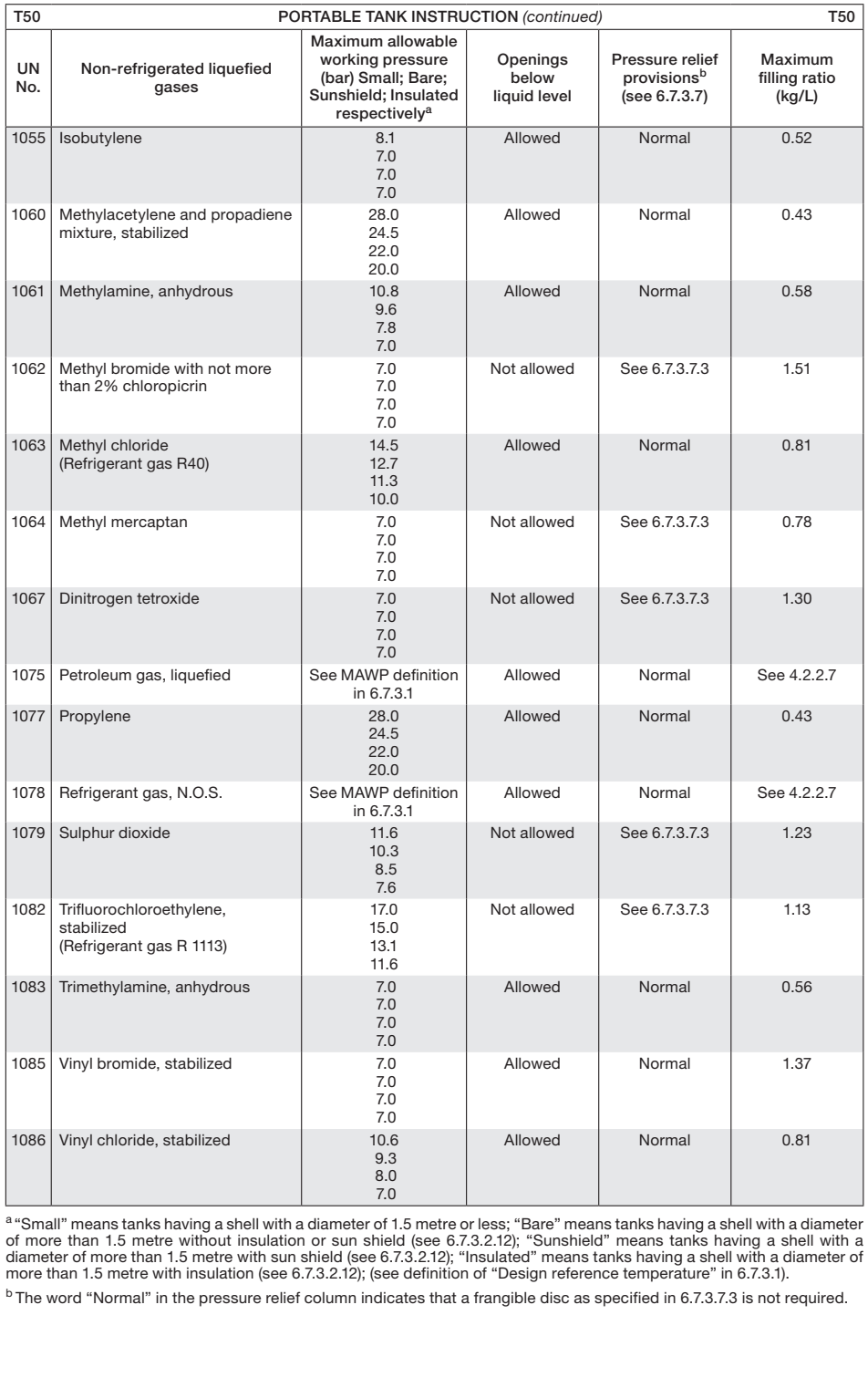
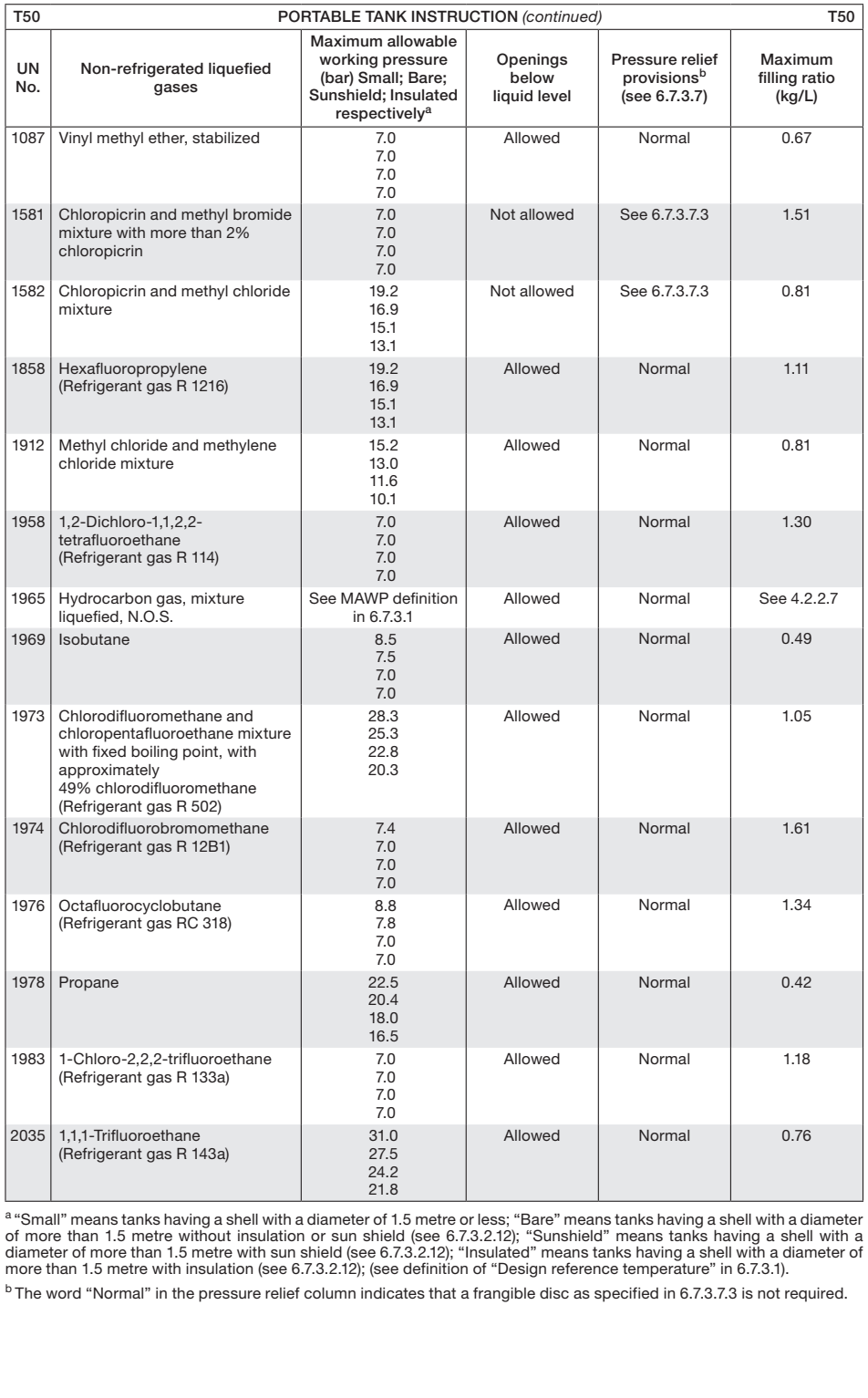
“Small” means tanks having a shell with a diameter of 1.5 metre or less; “Bare” means tanks having a shell with a diameter of more than 1.5 metre without insulation or sun shield (see 6.7.3.2.12); “Sunshield” means tanks having a shell with a diameter of more than 1.5 metre with sun shield (see 6.7.3.2.12); “Insulated” means tanks having a shell with a diameter of more than 1.5 metre with insulation (see 6.7.3.2.12); (see definition of “Design reference temperature” in 6.7.3.1).
b
The word “Normal” in the pressure relief column indicates that a frangible disc as specified in 6.7.3.7.3 is not required.
c
For UN Nos. 3500, 3501, 3502, 3503, 3504 and 3505, the degree of filling shall be considered instead of the maximum filling ratio.
Referenced filling and operating requirements
4.2.2.7.1
Prior to filling, the shipper shall ensure that the portable tank is approved for the non-refrigerated liquefied gas or the propellant of the chemical under pressure to be transported and that the portable tank is not loaded with non-refrigerated liquefied gases, or with chemicals under pressure which, in contact with the materials of the shell, gaskets and service equipment, are likely to react dangerously with them to form dangerous products or appreciably weaken these materials. During filling, the temperature of the non-refrigerated liquefied gas or propellant of chemicals under pressure shall fall within the limits of the design temperature range.
PDF 260
4.2.2.7.2
The maximum mass of non-refrigerated liquefied gas per litre of shell capacity (kg/L) shall not exceed the density of the non-refrigerated liquefied gas at 50°C multiplied by 0.95. Furthermore, the shell shall not be liquid-full at 60°C.
PDF 260
4.2.2.7.3
Portable tanks shall not be filled above their maximum permissible gross mass and the maximum permissible load mass specified for each gas to be transported.
PDF 260
4.2.2.7.4
Portable tanks shall not be filled or discharged while they remain on board.
PDF 260
TP4
The degree of filling shall not exceed 90% or, alternatively, any other value approved by the competent authority (see 4.2.1.16.2).
PDF 271
Original instruction, tables and continuation pages
Original pages are preserved as supplied. The readable display follows the verified English numerical values and references and, for T50, the December 2025 corrigendum. The original pages may therefore show superseded wording or source discrepancies.
T50 · 42-24 · PDF 266 · 1/6T50 · 42-24 · PDF 267 · 2/6T50 · 42-24 · PDF 268 · 3/6T50 · 42-24 · PDF 269 · 4/6T50 · 42-24 · PDF 270 · 5/6T50 · 42-24 · PDF 271 · 6/6
T50 This portable tank instruction applies to non-refrigerated liquefied gases and chemicals under pressure (UN Nos. 3500, 3501, 3502, 3503, 3504 and 3505). The general provisions of 4.2.2 and the provisions of 6.7.3 shall be met. Maximum allowable working pressure Openings Pressure relief Maximum UN Non-refrigerated liquefied (bar) Small; Bare; below provisionsb filling ratio No. gases Sunshield; Insulated liquid level (see 6.7.3.7) (kg/L) respectivelya 1005 Ammonia, anhydrous 29.0 Allowed See 6.7.3.7.3 0.53 25.7 22.0 19.7 1009 Bromotrifluoromethane 38.0 Allowed Normal 1.13 (Refrigerant gas R 13B1) 34.0 30.0 27.5 1010 Butadienes, stabilized 7.5 Allowed Normal 0.55 7.0 7.0 7.0 1010 Butadienes and hydrocarbon See MAWP definition Allowed Normal See 4.2.2.7 mixture, stabilized with more in 6.7.3.1 than 40% butadienes 1011 Butane 7.0 Allowed Normal 0.51 7.0 7.0 7.0 1012 Butylene 8.0 Allowed Normal 0.53 7.0 7.0 7.0 a “Small” means tanks having a shell with a diameter of 1.5 metre or less; “Bare” means tanks having a shell with a diameter of more than 1.5 metre without insulation or sun shield (see 6.7.3.2.12); “Sunshield” means tanks having a shell with a diameter of more than 1.5 metre with sun shield (see 6.7.3.2.12); “Insulated” means tanks having a shell with a diameter of more than 1.5 metre with insulation (see 6.7.3.2.12); (see definition of “Design reference temperature” in 6.7.3.1). b The word “Normal” in the pressure relief column indicates that a frangible disc as specified in 6.7.3.7.3 is not required. (continued) T50 Maximum allowable working pressure Openings Pressure relief Maximum UN Non-refrigerated liquefied (bar) Small; Bare; below provisionsb filling ratio No. gases Sunshield; Insulated liquid level (see 6.7.3.7) (kg/L) respectivelya 1017 Chlorine 19.0 Not allowed See 6.7.3.7.3 1.25 17.0 15.0 13.5 1018 Chlorodifluoromethane 26.0 Allowed Normal 1.03 (Refrigerant gas R 22) 24.0 21.0 19.0 1020 Chloropentafluoroethane 23.0 Allowed Normal 1.06 (Refrigerant gas R 115) 20.0 18.0 16.0 1021 1-Chloro-1,2,2,2- 10.3 Allowed Normal 1.20 tetrafluoroethane 9.8 (Refrigerant gas R 124) 7.9 7.0 1027 Cyclopropane 18.0 Allowed Normal 0.53 16.0 14.5 13.0 1028 Dichlorodifluoromethane 16.0 Allowed Normal 1.15 (Refrigerant gas R 12) 15.0 13.0 11.5 1029 Dichlorofluoromethane 7.0 Allowed Normal 1.23 (Refrigerant gas R 21) 7.0 7.0 7.0 1030 1,1-Difluoroethane 16.0 Allowed Normal 0.79 (Refrigerant gas R 152a) 14.0 12.4 11.0 1032 Dimethylamine, anhydrous 7.0 Allowed Normal 0.59 7.0 7.0 7.0 1033 Dimethyl ether 15.5 Allowed Normal 0.58 13.8 12.0 10.6 1036 Ethylamine 7.0 Allowed Normal 0.61 7.0 7.0 7.0 1037 Ethyl chloride 7.0 Allowed Normal 0.80 7.0 7.0 7.0 1040 Ethylene oxide with nitrogen – Not allowed See 6.7.3.7.3 0.78 up to a total pressure of 1 MPa – (10 bar) at 50C – ° 10.0 1041 Ethylene oxide and carbon See MAWP Allowed Normal See 4.2.2.7 dioxide mixture with more than definition 9% but not more than 87% in 6.7.3.1 ethylene oxide a “Small” means tanks having a shell with a diameter of 1.5 metre or less; “Bare” means tanks having a shell with a diameter of more than 1.5 metre without insulation or sun shield (see 6.7.3.2.12); “Sunshield” means tanks having a shell with a diameter of more than 1.5 metre with sun shield (see 6.7.3.2.12); “Insulated” means tanks having a shell with a diameter of more than 1.5 metre with insulation (see 6.7.3.2.12); (see definition of “Design reference temperature” in 6.7.3.1). b The word “Normal” in the pressure relief column indicates that a frangible disc as specified in 6.7.3.7.3 is not required. (continued) T50 Maximum allowable working pressure Openings Pressure relief Maximum UN Non-refrigerated liquefied (bar) Small; Bare; below provisionsb filling ratio No. gases Sunshield; Insulated liquid level (see 6.7.3.7) (kg/L) respectivelya 1055 Isobutylene 8.1 Allowed Normal 0.52 7.0 7.0 7.0 1060 Methylacetylene and propadiene 28.0 Allowed Normal 0.43 mixture, stabilized 24.5 22.0 20.0 1061 Methylamine, anhydrous 10.8 Allowed Normal 0.58 9.6 7.8 7.0 1062 Methyl bromide with not more 7.0 Not allowed See 6.7.3.7.3 1.51 than 2% chloropicrin 7.0 7.0 7.0 1063 Methyl chloride 14.5 Allowed Normal 0.81 (Refrigerant gas R40) 12.7 11.3 10.0 1064 Methyl mercaptan 7.0 Not allowed See 6.7.3.7.3 0.78 7.0 7.0 7.0 1067 Dinitrogen tetroxide 7.0 Not allowed See 6.7.3.7.3 1.30 7.0 7.0 7.0 4 1075 Petroleum gas, liquefied See MAWP definition Allowed Normal See 4.2.2.7 in 6.7.3.1 1077 Propylene 28.0 Allowed Normal 0.43 24.5 22.0 20.0 1078 Refrigerant gas, N.O.S. See MAWP definition Allowed Normal See 4.2.2.7 in 6.7.3.1 1079 Sulphur dioxide 11.6 Not allowed See 6.7.3.7.3 1.23 10.3 8.5 7.6 1082 Trifluorochloroethylene, 17.0 Not allowed See 6.7.3.7.3 1.13 stabilized 15.0 (Refrigerant gas R 1113) 13.1 11.6 1083 Trimethylamine, anhydrous 7.0 Allowed Normal 0.56 7.0 7.0 7.0 1085 Vinyl bromide, stabilized 7.0 Allowed Normal 1.37 7.0 7.0 7.0 1086 Vinyl chloride, stabilized 10.6 Allowed Normal 0.81 9.3 8.0 7.0 a “Small” means tanks having a shell with a diameter of 1.5 metre or less; “Bare” means tanks having a shell with a diameter of more than 1.5 metre without insulation or sun shield (see 6.7.3.2.12); “Sunshield” means tanks having a shell with a diameter of more than 1.5 metre with sun shield (see 6.7.3.2.12); “Insulated” means tanks having a shell with a diameter of more than 1.5 metre with insulation (see 6.7.3.2.12); (see definition of “Design reference temperature” in 6.7.3.1). b The word “Normal” in the pressure relief column indicates that a frangible disc as specified in 6.7.3.7.3 is not required. (continued) T50 Maximum allowable working pressure Openings Pressure relief Maximum UN Non-refrigerated liquefied (bar) Small; Bare; below provisionsb filling ratio No. gases Sunshield; Insulated liquid level (see 6.7.3.7) (kg/L) respectivelya 1087 Vinyl methyl ether, stabilized 7.0 Allowed Normal 0.67 7.0 7.0 7.0 1581 Chloropicrin and methyl bromide 7.0 Not allowed See 6.7.3.7.3 1.51 mixture with more than 2% 7.0 chloropicrin 7.0 7.0 1582 Chloropicrin and methyl chloride 19.2 Not allowed See 6.7.3.7.3 0.81 mixture 16.9 15.1 13.1 1858 Hexafluoropropylene 19.2 Allowed Normal 1.11 (Refrigerant gas R 1216) 16.9 15.1 13.1 1912 Methyl chloride and methylene 15.2 Allowed Normal 0.81 chloride mixture 13.0 11.6 10.1 1958 1,2-Dichloro-1,1,2,2- 7.0 Allowed Normal 1.30 tetrafluoroethane 7.0 (Refrigerant gas R 114) 7.0 7.0 1965 Hydrocarbon gas, mixture See MAWP definition Allowed Normal See 4.2.2.7 liquefied, N.O.S. in 6.7.3.1 1969 Isobutane 8.5 Allowed Normal 0.49 7.5 7.0 7.0 1973 Chlorodifluoromethane and 28.3 Allowed Normal 1.05 chloropentafluoroethane mixture 25.3 with fixed boiling point, with 22.8 approximately 20.3 49% chlorodifluoromethane (Refrigerant gas R 502) 1974 Chlorodifluorobromomethane 7.4 Allowed Normal 1.61 (Refrigerant gas R 12B1) 7.0 7.0 7.0 1976 Octafluorocyclobutane 8.8 Allowed Normal 1.34 (Refrigerant gas RC 318) 7.8 7.0 7.0 1978 Propane 22.5 Allowed Normal 0.42 20.4 18.0 16.5 1983 1-Chloro-2,2,2-trifluoroethane 7.0 Allowed Normal 1.18 (Refrigerant gas R 133a) 7.0 7.0 7.0 2035 1,1,1-Trifluoroethane 31.0 Allowed Normal 0.76 (Refrigerant gas R 143a) 27.5 24.2 21.8 a “Small” means tanks having a shell with a diameter of 1.5 metre or less; “Bare” means tanks having a shell with a diameter of more than 1.5 metre without insulation or sun shield (see 6.7.3.2.12); “Sunshield” means tanks having a shell with a diameter of more than 1.5 metre with sun shield (see 6.7.3.2.12); “Insulated” means tanks having a shell with a diameter of more than 1.5 metre with insulation (see 6.7.3.2.12); (see definition of “Design reference temperature” in 6.7.3.1). b The word “Normal” in the pressure relief column indicates that a frangible disc as specified in 6.7.3.7.3 is not required. (continued) T50 Maximum allowable working pressure Openings Pressure relief Maximum UN Non-refrigerated liquefied (bar) Small; Bare; below provisionsb filling ratio No. gases Sunshield; Insulated liquid level (see 6.7.3.7) (kg/L) respectivelya 2424 Octafluoropropane 23.1 Allowed Normal 1.07 (Refrigerant gas R 218) 20.8 18.6 16.6 2517 1-Chloro-1,1-difluoroethane 8.9 Allowed Normal 0.99 (Refrigerant gas R 142b) 7.8 7.0 7.0 2602 Dichlorodifluoromethane and 20.0 Allowed Normal 1.01 difluoroethane azeotropic 18.0 mixture with approximately 16.0 74% dichlorodifluoromethane 14.5 (Refrigerant gas R 500) 3057 Trifluoroacetyl chloride 14.6 Not allowed See 6.7.3.7.3 1.17 12.9 11.3 9.9 3070 Ethylene oxide and 14.0 Allowed See 6.7.3.7.3 1.09 dichlorodifluoromethane 12.0 mixture, with not more 11.0 than 12.5% ethylene oxide 9.0 3153 Perfluoro(methyl vinyl ether) 14.3 Allowed Normal 1.14 13.4 11.2 10.2 3159 1,1,1,2-Tetrafluoroethane 17.7 Allowed Normal 1.04 (Refrigerant gas R 134a) 15.7 13.8 4 12.1 3161 Liquefied gas, flammable, N.O.S. See MAWP definition Allowed Normal See 4.2.2.7 in 6.7.3.1 3163 Liquefied gas, N.O.S. See MAWP definition Allowed Normal See 4.2.2.7 in 6.7.3.1 3220 Pentafluoroethane 34.4 Allowed Normal 0.87 (Refrigerant gas R 125) 30.8 27.5 24.5 3252 Difluoromethane 43.0 Allowed Normal 0.78 (Refrigerant gas R 32) 39.0 34.4 30.5 3296 Heptafluoropropane 16.0 Allowed Normal 1.20 (Refrigerant gas R 227) 14.0 12.5 11.0 3297 Ethylene oxide and 8.1 Allowed Normal 1.16 chlorotetrafluoroethane mixture, 7.0 with not more than 8.8% 7.0 ethylene oxide 7.0 3298 Ethylene oxide and 25.9 Allowed Normal 1.02 pentafluoroethane mixture, with 23.4 not more than 7.9% ethylene 20.9 oxide 18.6 3299 Ethylene oxide and 16.7 Allowed Normal 1.03 tetrafluoroethane mixture, with 14.7 not more than 5.6% ethylene 12.9 oxide 11.2 a “Small” means tanks having a shell with a diameter of 1.5 metre or less; “Bare” means tanks having a shell with a diameter of more than 1.5 metre without insulation or sun shield (see 6.7.3.2.12); “Sunshield” means tanks having a shell with a diameter of more than 1.5 metre with sun shield (see 6.7.3.2.12); “Insulated” means tanks having a shell with a diameter of more than 1.5 metre with insulation (see 6.7.3.2.12); (see definition of “Design reference temperature” in 6.7.3.1). b The word “Normal” in the pressure relief column indicates that a frangible disc as specified in 6.7.3.7.3 is not required. (continued) T50 Maximum allowable working pressure Openings Pressure relief Maximum UN Non-refrigerated liquefied (bar) Small; Bare; below provisionsb filling ratio No. gases Sunshield; Insulated liquid level (see 6.7.3.7) (kg/L) respectivelya 3318 Ammonia solution, relative See MAWP definition Allowed See 6.7.3.7.3 See 4.2.2.7 density less than 0.880 at 15C in 6.7.3.1 ° in water, with more than 50% ammonia 3337 Refrigerant gas R 404A 31.6 Allowed Normal 0.82 28.3 25.3 22.5 3338 Refrigerant gas R 407A 31.3 Allowed Normal 0.94 28.1 25.1 22.4 3339 Refrigerant gas R 407B 33.0 Allowed Normal 0.93 29.6 26.5 23.6 3340 Refrigerant gas R 407C 29.9 Allowed Normal 0.95 26.8 23.9 21.3 3500 Chemical under pressure, n.o.s. See MAWP definition Allowed See 6.7.3.7.3 TP4c in 6.7.3.1 3501 Chemical under pressure, See MAWP definition Allowed See 6.7.3.7.3 TP4c flammable, n.o.s. in 6.7.3.1 3502 Chemical under pressure, toxic, See MAWP definition Allowed See 6.7.3.7.3 TP4c n.o.s. in 6.7.3.1 3503 Chemical under pressure, See MAWP definition Allowed See 6.7.3.7.3 TP4c corrosive, n.o.s. in 6.7.3.1 3504 Chemical under pressure, See MAWP definition Allowed See 6.7.3.7.3 TP4c flammable, toxic, n.o.s. in 6.7.3.1 3505 Chemical under pressure, See MAWP definition Allowed See 6.7.3.7.3 TP4c flammable, corrosive, n.o.s. in 6.7.3.1 a “Small” means tanks having a shell with a diameter of 1.5 metre or less; “Bare” means tanks having a shell with a diameter of more than 1.5 metre without insulation or sun shield (see 6.7.3.2.12); “Sunshield” means tanks having a shell with a diameter of more than 1.5 metre with sun shield (see 6.7.3.2.12); “Insulated” means tanks having a shell with a diameter of more than 1.5 metre with insulation (see 6.7.3.2.12); (see definition of “Design reference temperature” in 6.7.3.1). b The word “Normal” in the pressure relief column indicates that a frangible disc as specified in 6.7.3.7.3 is not required. c For UN Nos. 3500, 3501, 3502, 3503, 3504 and 3505, the degree of filling shall be considered instead of the maximum filling ratio.
For the purposes of documentation and package marking, the proper shipping name shall be supplemented with the technical name (see 3.1.2.8.1). For UN 3077 and UN 3082 only, the technical name may be a name shown in capital letters in column 2 of the Dangerous Goods List, provided that this name does not include “N.O.S.” and that special provision 274 is not assigned. The name which most appropriately describes the substance or mixture shall be used, e.g.: UN 3082, ENVIRONMENTALLY HAZARDOUS SUBSTANCE, LIQUID, N.O.S. (PAINT) UN 3082, ENVIRONMENTALLY HAZARDOUS SUBSTANCE, LIQUID, N.O.S. (PERFUMERY PRODUCTS).
This entry applies to liquids, pastes or powders, pressurized with a propellant which meets the definition of a gas in 2.2.1.1 and 2.2.1.2.1 or 2.2.1.2.2. Note: A chemical under pressure in an aerosol dispenser shall be transported under UN 1950. The following provisions shall apply:.1 the chemical under pressure shall be classified based on the hazard characteristics of the components in the different states: – the propellant; – the liquid; or – the solid. If one of these components, which can be a pure substance or a mixture, needs to be classified as flammable, the chemical under pressure shall be classified as flammable in class 2.1. Flammable components are flammable liquids and liquid mixtures, flammable solids and solid mixtures or flammable gases and gas mixtures meeting the following criteria:.1 a flammable liquid is a liquid having a flashpoint of not more than 93C; °.2 a flammable solid is a solid which meets the criteria in 2.4.2.2 of this Code;.3 a flammable gas is a gas which meets the criteria in 2.2.2.1 of this Code;.2 gases of class 2.3 and gases with a subsidiary hazard of 5.1 shall not be used as a p ropellant in a chemical under pressure;.3 where the liquid or solid components are classified as dangerous goods of class 6.1, packing groups II or III, or class 8, packing groups II or III, the chemical under pressure shall be assigned a subsidiary hazard of class 6.1 or class 8 and the appropriate UN number shall be assigned. Components classified in class 6.1, packing group I, or class 8, packing group I, shall not be used for transport under this proper shipping name;.4 in addition, chemicals under pressure with components meeting the properties of: class 1, explosives; class 3, liquid desensitized explosives; class 4.1, self-reactive substances and solid desensitized explosives; class 4.2, substances liable to spontaneous combustion; class 4.3, substances which, in contact with water, emit flammable gases; class 5.1, oxidizing substances; class 5.2, organic peroxides; class 6.2, Infectious substances or class 7, Radioactive material, shall not be used for transport under this proper shipping name;.5 substances to which PP86 or TP7 are assigned in column 9 and column 14 of the Dangerous Goods List in chapter 3.2 and therefore require air to be eliminated from the vapour space, shall not be used for transport under this UN number but shall be transported under their respective UN numbers as listed in the Dangerous Goods List of chapter 3.2.
Reference preview for Entry 1. Confirm the cargo classification and any conditions in the special provisions.
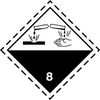
Non-toxic non-flamm. gas 2.2Corrosive 8
⚠ The marine pollutant (MP) status must be determined from the actual consignment: this is a generic N.O.S. entry, and no "P" in column 4 of the Index does not exclude applicability (2.10.2.4). Per 2.10.2.5, if the consignment meets the marine pollutant criteria of 2.9.3 it must be carried as a marine pollutant with the MP mark.