IMDG Code 42-24 · Dangerous Goods List

Open interactive lookup ↗

UN3516ADSORBED GAS, TOXIC, CORROSIVE, N.O.S.

English proper shipping name · Check the cargo and applicable provisions before shipment.

Class2.3
Packing groupNot assigned in this entry
EmSF-C, S-U

Dangerous Goods List entries

The comparison below lists all entries. Expanded provisions and the label preview on this page apply to Entry 1.

Compare all 1 DGL entry

Entry 1

ADSORBED GAS, TOXIC, CORROSIVE, N.O.S.

Class
2.3
Subsidiary risk / reference
8
Packing group
Not assigned in this entry
Marine pollutant entry
Not listed; check the cargo classification
Limited quantities
0
Excepted quantities
E0
Packing instruction
P208
Special provisions
274 379
Special packing provision
Not listed
IBC instruction
Not listed
IBC special provisions
Not listed
Portable tank / bulk container codes
Not listed
Tank special provisions
Not listed
EmS
F-C, S-U
Stowage and handling
Category D SW2 Category D SW2
Segregation
Not listed in this DGL field

Packing and large packaging instructions

P208

Source pages and references

Check original English pages and footnotes ↗ · official PDF 198–199

P208 This instruction applies to class 2 adsorbed gases. (1) The following packagings are authorized provided the general packing requirements of 4.1.6.1 are met: (a) cylinders constructed as specified in 6.2.2 and in accordance with ISO 11513:2011, ISO 11513:2019, ISO 9809-1:2010 or ISO 9809-1:2019; and (b) cylinders constructed before 1 January 2016 in accordance with 6.2.3 and a specification approved by the competent authorities of the countries of transport and use. (2) The pressure of each filled cylinder shall be less than 101.3 kPa at 20C and less than 300 kPa at 50C. ° ° (3) The minimum test pressure of the cylinder shall be 21 bar. (4) The minimum burst pressure of the cylinder shall be 94.5 bar. (5) The internal pressure at 65C of the filled cylinder shall not exceed the test pressure of the cylinder. ° (6) The adsorbent material shall be compatible with the cylinder and shall not form harmful or dangerous compounds with the gas to be adsorbed. The gas in combination with the adsorbent material shall not affect or weaken the 4 cylinder or cause a dangerous reaction (e.g. a catalyzing reaction). (7) The quality of the adsorbent material shall be verified at the time of each fill to assure the pressure and chemical stability requirements of this packing instruction are met each time an adsorbed gas package is offered for transport. (8) The adsorbent material shall not meet the criteria of any of the classes or divisions in this Code. (9) Requirements for cylinders and closures containing toxic gases with an LC less than or equal to mL/m3 (ppm) (see table 1) shall be as follows: (a) Valve outlets shall be fitted with pressure retaining gas-tight plugs or caps having threads matching those of the valve outlets. (b) Each valve shall either be of the packless type with non-perforated diaphragm, or be of a type which prevents leakage through or past the packing. (c) Each cylinder and closure shall be tested for leakage after filling. (d) Each valve shall be capable of withstanding the test pressure of the cylinder and be directly connected to the cylinder by either a taper-thread or other means which meets the requirements of ISO 10692-2:2001. (e) Cylinders and valves shall not be fitted with a pressure relief device. (10) Valve outlets for cylinders containing pyrophoric gases shall be fitted with gas-tight plugs or caps having threads matching those of the valve outlets. (11) The filling procedure shall be in accordance with annex A of ISO 11513:2011 (applicable until 31 December 2024) or annex A of ISO 11513:2019. (12) The maximum period for periodic inspections shall be 5 years. (13) Special packing provisions that are specific to a substance (see table 1). Material compatibility a: Aluminium alloy cylinders shall not be used. d: When steel cylinders are used, only those bearing the “H” mark in accordance with 6.2.2.7.4 (p) are permitted. Gas specific provisions r: The filling ratio of this gas shall be limited such that, if complete decomposition occurs, the pressure does not exceed two thirds of the test pressure of the cylinder. Material compatibility for N.O.S. adsorbed gas entries z: The construction materials of the cylinders and their accessories shall be compatible with the contents and shall not react to form harmful or dangerous compounds therewith. (continued) P208 Table 1: ADSORBED GASES Special UN Class or Subsidiary LC Proper shipping name 50 packing No. Division hazard mL/m3 provisions ⊗ 3510 ADSORBED GAS, FLAMMABLE, N.O.S. 2.1 z 3511 ADSORBED GAS, N.O.S. 2.2 z 3512 ADSORBED GAS, TOXIC, N.O.S. 2.3 5,000 z ≤ 3513 ADSORBED GAS, OXIDIZING, N.O.S. 2.2 5.1 z 3514 ADSORBED GAS, TOXIC, FLAMMABLE, N.O.S. 2.3 2.1 5,000 z ≤ 3515 ADSORBED GAS, TOXIC, OXIDIZING, N.O.S. 2.3 5.1 5,000 z ≤ 3516 ADSORBED GAS, TOXIC, CORROSIVE, N.O.S. 2.3 8 5,000 z ≤ 3517 ADSORBED GAS, TOXIC, FLAMMABLE, 2.3 2.1 5,000 z ≤ CORROSIVE, N.O.S. 8 3518 ADSORBED GAS, TOXIC, OXIDIZING, 2.3 5.1 5,000 z ≤ CORROSIVE, N.O.S. 8 3519 BORON TRIFLUORIDE, ADSORBED 2.3 8 387 a 3520 CHLORINE, ADSORBED 2.3 5.1 293 a 3521 SILICON TETRAFLUORIDE, ADSORBED 2.3 8 450 a 3522 ARSINE, ADSORBED 2.3 2.1 20 d 3523 GERMANE, ADSORBED 2.3 2.1 620 d, r 3524 PHOSPHORUS PENTAFLUORIDE, ADSORBED 2.3 8 190 3525 PHOSPHINE, ADSORBED 2.3 2.1 20 d 3526 HYDROGEN SELENIDE, ADSORBED 2.3 2.1 2

IMDG Code 42-24 · English source text
Special provisions

SP 274

Source pages and references

Check original English pages and footnotes ↗ · official PDF 761–761

For the purposes of documentation and package marking, the proper shipping name shall be supplemented with the technical name (see 3.1.2.8.1). For UN 3077 and UN 3082 only, the technical name may be a name shown in capital letters in column 2 of the Dangerous Goods List, provided that this name does not include “N.O.S.” and that special provision 274 is not assigned. The name which most appropriately describes the substance or mixture shall be used, e.g.: UN 3082, ENVIRONMENTALLY HAZARDOUS SUBSTANCE, LIQUID, N.O.S. (PAINT) UN 3082, ENVIRONMENTALLY HAZARDOUS SUBSTANCE, LIQUID, N.O.S. (PERFUMERY PRODUCTS).

IMDG Code 42-24 · English source text
SP 379

Source pages and references

Check original English pages and footnotes ↗ · official PDF 774–774

Anhydrous ammonia adsorbed on a solid or absorbed in a solid contained in ammonia dispensing systems or receptacles intended to form part of such systems are not subject to the other provisions of this Code if the following conditions are observed:.1 The adsorption or absorption presents the following properties:.1 the pressure at a temperature of 20°C in the receptacle is less than 0.6 bar;.2 the pressure at a temperature of 35°C in the receptacle is less than 1 bar;.3 the pressure at a temperature of 85°C in the receptacle is less than 12 bar;.2 The adsorbent or absorbent material shall not have dangerous properties listed in classes 1 to 8;.3 The maximum contents of a receptacle shall be 10 kg of ammonia; and.4 Receptacles containing adsorbed or absorbed ammonia shall meet the following conditions:.1 receptacles shall be made of a material compatible with ammonia as specified in ISO 11114-1:2020;.2 receptacles and their means of closure shall be hermetically sealed and able to contain the generated ammonia;.3 each receptacle shall be able to withstand the pressure generated at 85°C with a volumetric expansion no greater than 0.1%;.4 each receptacle shall be fitted with a device that allows for gas evacuation once pressure exceeds 15 bar without violent rupture, explosion or projection; and.5 each receptacle shall be able to withstand a pressure of 20 bar without leakage when the pressure relief device is deactivated. When transported in an ammonia dispenser, the receptacles shall be connected to the dispenser in such a way that the assembly is guaranteed to have the same strength as a single receptacle. The properties of mechanical strength mentioned in this special provision shall be tested using a prototype of a receptacle and/or dispenser filled to nominal capacity, by increasing the temperature until the specified pressures are reached. The test results shall be documented, shall be traceable and shall be communicated to the relevant authorities upon request.

IMDG Code 42-24 · English source text

Stowage and handling codes

Labels and marks

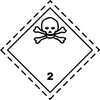
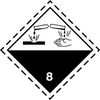
Reference preview for Entry 1. Confirm the cargo classification and any conditions in the special provisions.

Toxic gas 2.3
Toxic gas 2.3
Corrosive 8
Corrosive 8

⚠ The marine pollutant (MP) status must be determined from the actual consignment: this is a generic N.O.S. entry, and no "P" in column 4 of the Index does not exclude applicability (2.10.2.4). Per 2.10.2.5, if the consignment meets the marine pollutant criteria of 2.9.3 it must be carried as a marine pollutant with the MP mark.

Explore this class