Subsidiary hazards shall be representative of the primary hazard posed by the other dangerous goods contained within the article. When only one dangerous good is present in the article, the subsidiary hazard(s), if any, shall be the subsidiary hazard(s) identified in column 4 of the Dangerous Goods List. If the article contains more than one dangerous good and these could react dangerously with one another during transport, each of the dangerous goods shall be enclosed separately (see 4.1.1.6).
IMDG Code 42-24 · English source PDF p. 62
2.0.6.5 · Classification of articles
Articles containing dangerous goods shall be assigned to the appropriate class determined by the hazards present using, where applicable, the Precedence of Hazards table in 2.0.3.6 for each of the dangerous goods contained in the article. If dangerous goods classified as class 9 are contained within the article, all other dangerous goods present in the article shall be considered to present a higher hazard.
IMDG Code 42-24 · English source PDF p. 62
4.1.1.6 · Dangerous reactions in common packaging
Dangerous goods shall not be packed together in the same outer packaging, or in large packagings, with dangerous or other goods if they react dangerously with each other and cause: .1 combustion and/or evolution of considerable heat; .2 evolution of flammable, toxic or asphyxiant gases; .3 the formation of corrosive substances; or .4 the formation of unstable substances.
For the purposes of documentation and package marking, the proper shipping name shall be supplemented with the technical name (see 3.1.2.8.1). For UN 3077 and UN 3082 only, the technical name may be a name shown in capital letters in column 2 of the Dangerous Goods List, provided that this name does not include “N.O.S.” and that special provision 274 is not assigned. The name which most appropriately describes the substance or mixture shall be used, e.g.: UN 3082, ENVIRONMENTALLY HAZARDOUS SUBSTANCE, LIQUID, N.O.S. (PAINT) UN 3082, ENVIRONMENTALLY HAZARDOUS SUBSTANCE, LIQUID, N.O.S. (PERFUMERY PRODUCTS).
Articles containing dangerous goods of class 2.3, or class 4.2, or class 4.3, or class 5.1, or class 5.2 or class 6.1 for substances of inhalation toxicity requiring packing group I and articles containing more than one of the hazards listed in 2.0.3.4.2 to 2.0.3.4.4 shall be transported under conditions approved by the competent authority.
IMDG Code 42-24 · English source text
Labels and marks
Reference preview for Entry 1. Confirm the cargo classification and any conditions in the special provisions.
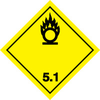
Oxidizer 5.1
Subsidiary hazards pending (2.0.6.6): this label preview is incomplete; confirm the actual consignment and referenced requirements before completing subsidiary labels.
⚠ The marine pollutant (MP) status must be determined from the actual consignment: this is a generic N.O.S. entry, and no "P" in column 4 of the Index does not exclude applicability (2.10.2.4). Per 2.10.2.5, if the consignment meets the marine pollutant criteria of 2.9.3 it must be carried as a marine pollutant with the MP mark.