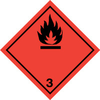
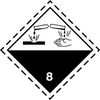
Colourless, very volatile liquid with a pungent odour. Flashpoint: 26 C c.c. Explosive limits: 4.5% to 70%. - ° Boiling point: 41 C. Immiscible with water. Reacts violently with water ° or steam to produce heat which may lead to self-ignition; toxic and corrosive fumes will be evolved. May react vigorously in contact with oxidizing substances. Causes burns to skin, eyes and mucous membranes.
P401 The following packagings are authorized, provided that the general provisions of 4.1.1 and 4.1.3 are met: (1) Pressure receptacles, provided that the general provisions of 4.1.3.6 are met. They shall be made of steel and subjected to an initial test and periodic tests every 10 years at a pressure of not less than 0.6 MPa (6 bar, gauge pressure). During carriage, the liquid shall be under a layer of inert gas with a gauge pressure of not less than kPa (0.2 bar). (2) Combination packagings Outer packagings: Drums (1A1, 1A2, 1B1, 1B2, 1N1, 1N2, 1H1, 1H2, 1D, 1G); Boxes (4A, 4B, 4N, 4C1, 4C2, 4D, 4F, 4G, 4H1,4H2); Jerricans (3A1, 3A2, 3B1, 3B2, 3H1, 3H2). Inner packagings: Glass, metal or plastics which have threaded closures with a maximum capacity of 1 L. Each inner packaging shall be surrounded by inert cushioning and absorbent material in a quantity sufficient to absorb the entire contents. The maximum net mass per outer packaging shall not exceed 30 kg. Special packing provision: PP31 For UN Nos. 1183, 1242, 1295, 2965 and 2988, packagings shall be hermetically sealed.
These portable tank instructions apply to liquid and solid substances of class 1 and classes 3 to 9. The general provisions of section 4.2.1 and the requirements of section 6.7.2 shall be met. The instructions for portable tanks with FRP shells apply to substances of classes or divisions 1, 3, 5.1, 6.1, 6.2, 8 and 9. Additionally, the provisions of chapter 6.10 apply to the portable tanks with FRP shells.
T14 · Selected instruction · IMDG 42-24
Portable tank instruction
Minimum test pressure (bar)
Minimum shell thickness (in mm – reference steel) (see 6.7.2.4)
Pressure relief provisionsa (see 6.7.2.8)
Bottom opening provisionsb (see 6.7.2.6)
T14
6
6 mm
See 6.7.2.8.3
Not allowed
a When the word “Normal” is indicated, all the provisions of 6.7.2.8 apply except for 6.7.2.8.3.
b When this column indicates “not allowed”, bottom openings are not permitted when the substance to be transported
is a liquid (see 6.7.2.6.1). When the substance to be transported is a solid at all temperatures encountered under normal
conditions of transport, bottom openings conforming to the provisions of 6.7.2.6.2 are authorized.
Source PDF pages:264 · 42-24
Extracted source text
S T1 – T22 These portable tank instructions apply to liquid and solid substances of class 1 and classes 3 to 9. The general provisions of section 4.2.1 and the requirements of section 6.7.2 shall be met. The instructions for portable tanks with FRP shells apply to substances of classes or divisions 1, 3, 5.1, 6.1, 6.2, 8 and 9. Additionally, the provisions of chapter 6.10 apply to the portable tanks with FRP shells. Minimum shell thickness Pressure relief Bottom opening (in mm – reference provisionsa provisionsb instruction pressure (bar) steel) (see 6.7.2.8) (see 6.7.2.6) (see 6.7.2.4) 6 6 mm See 6.7.2.8.3 Not allowed
Self-contained breathing apparatus shall be provided when this substance is transported, unless no self-contained breathing apparatus, as required by SOLAS regulation II-2/19 (II-2/54), is on board.
In addition: from goods of classes 2.1 and 3 when stowed on deck of a containership a minimum distance of two container spaces athwartship shall be maintained, when stowed on ro-ro ships a distance of 6 m athwartship shall be maintained.