P003 Dangerous goods shall be placed in suitable outer packagings. The packagings shall meet the provisions of 4.1.1.1, 4.1.1.2, 4.1.1.4, 4.1.1.8 and 4.1.3 and be so designed that they meet the construction provisions of 6.1.4. Outer packagings constructed of suitable material, and of adequate strength and design in relation to the packaging capacity and its intended use, shall be used. Where this packing instruction is used for the transport of articles or inner packagings of combination packagings, the packaging shall be designed and constructed to prevent inadvertent discharge of articles during normal conditions of transport. Special packing provisions: PP16 For UN 2800, batteries shall be protected from short circuit within the packagings. PP17 For UN 2037, packages shall not exceed 55 kg net mass for fibreboard packagings or 125 kg net mass for other packagings. PP18 For UN 1845, packagings shall be designed and constructed to permit the release of carbon dioxide gas to prevent a build-up of pressure that could rupture the packagings. PP19 For UN Nos. 1327, 1364, 1365, 1856 and 3360, transport as bales is authorized. PP20 For UN Nos. 1363, 1386, 1408 and 2793, any sift-proof, tearproof receptacle may be used. PP32 UN Nos. 2857 and 3358 and robust articles consigned under UN 3164 may be transported unpackaged, in crates or in appropriate overpacks. Note: The packagings authorized may exceed a net mass of 400 kg (see 4.1.3.3). PP90 For UN Nos. 3506 and 3554, sealed inner liners or bags of strong leakproof and puncture resistant material impervious to mercury or gallium, as appropriate, which will prevent escape of the substance from the package irrespective of the position of the package shall be used. PP91 For UN 1044, large fire extinguishers may also be transported unpackaged provided that the requirements of 4.1.3.8.1.1 to 4.1.3.8.1.5 are met, the valves are protected by one of the methods in accordance with 4.1.6.1.8.1 to 4.1.6.1.8.4 and other equipment mounted on the fire extinguisher is protected to prevent accidental activation. For the purpose of this special packing provision, “large fire extinguishers” means fire extinguishers as described in subparagraphs.3 to.5 of special provision 225 of chapter 3.3. PP96 For UN 2037 waste gas cartridges transported in accordance with special provision 327, the packagings shall be adequately ventilated to prevent the creation of dangerous atmospheres and the build-up of pressure. PP100 For UN Nos. 1408 and 2793 flexible, fibreboard or wooden packagings shall be sift-proof and water-resistant or shall be fitted with a sift-proof and water-resistant liner.
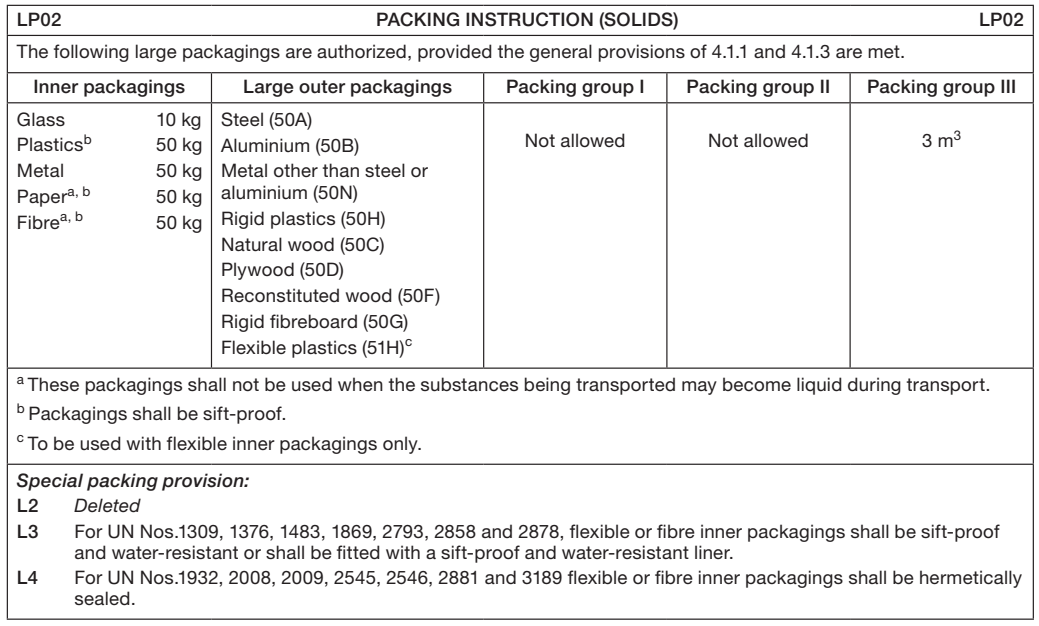
The following large packagings are authorized, provided the general provisions of 4.1.1 and 4.1.3 are met.
Use the instruction and packing group assigned to the selected DGL entry. Inner-packaging limits and outer-packaging limits apply together; also check the assigned special packing provisions.
These packagings shall not be used when the substances being transported may become liquid during transport.
b
Packagings shall be sift-proof.
c
To be used with flexible inner packagings only.
Special packing provisions in this instruction · 3
Only the provisions assigned to the selected DGL entry apply.
L2 Deleted
L3 For UN Nos.1309, 1376, 1483, 1869, 2793, 2858 and 2878, flexible or fibre inner packagings shall be sift-proof and water-resistant or shall be fitted with a sift-proof and water-resistant liner.
L4 For UN Nos.1932, 2008, 2009, 2545, 2546, 2881 and 3189 flexible or fibre inner packagings shall be hermetically sealed.
IMDG 42-24 · Source PDF pages:240
Check the original table and continuation pages
Original table and continuation pages. Read the applicable packing group, footnotes and assigned special provisions together. Open an image to zoom.
LP02 · 42-24 · PDF 240 · 1/1
Extracted source text
(SOLIDS) LP02 The following large packagings are authorized, provided the general provisions of 4.1.1 and 4.1.3 are met. Inner packagings Large outer packagings Packing group I Packing group II Packing group III 4 Glass 10 kg Steel (50A) Plasticsb 50 kg Aluminium (50B) Not allowed Not allowed 3 m3 Metal 50 kg Metal other than steel or Papera, b 50 kg aluminium (50N) Fibrea, b 50 kg Rigid plastics (50H) Natural wood (50C) Plywood (50D) Reconstituted wood (50F) Rigid fibreboard (50G) Flexible plastics (51H)c a These packagings shall not be used when the substances being transported may become liquid during transport. b Packagings shall be sift-proof. c To be used with flexible inner packagings only. Special packing provision: L2 Deleted L3 For UN Nos.1309, 1376, 1483, 1869, 2793, 2858 and 2878, flexible or fibre inner packagings shall be sift-proof and water-resistant or shall be fitted with a sift-proof and water-resistant liner. L4 For UN Nos.1932, 2008, 2009, 2545, 2546, 2881 and 3189 flexible or fibre inner packagings shall be hermetically sealed.
IBC08 The following IBCs are authorized, provided the general provisions of 4.1.1, 4.1.2 and 4.1.3 are met: Metal (11A, 11B, 11N, 21A, 21B, 21N, 31A, 31B and 31N); Rigid plastics (11H1, 11H2, 21H1, 21H2, 31H1 and 31H2); Composite (11HZ1, 11HZ2, 21HZ1, 21HZ2 and 31HZ1); Fibreboard (11G); Wooden (11C, 11D and 11F); Flexible (13H1, 13H2, 13H3, 13H4, 13H5, 13L1, 13L2, 13L3, 13L4, 13M1 or 13M2). Additional provisions: Where the solid may become liquid during transport see 4.1.3.4. Special packing provisions: B3 Flexible IBCs shall be sift-proof and water-resistant or shall be fitted with a sift-proof and water-resistant liner. B4 Flexible, fibreboard or wooden IBCs shall be sift-proof and water-resistant or shall be fitted with a sift-proof and water-resistant liner. B6 For UN Nos. 1327, 1363, 1364, 1365, 1386, 1408, 1841, 2211, 2217, 2793 and 3314, IBCs are not required to meet the IBC testing provisions of chapter 6.5. B21 For solid substances in IBCs other than metal or rigid plastics IBCs, the IBCs shall be carried in closed cargo transport units or in freight containers/vehicles, which shall have rigid sides or fences at least to the height of the IBC.
For UN Nos. 1327, 1363, 1364, 1365, 1386, 1408, 1841, 2211, 2217, 2793 and 3314, IBCs are not required to meet the IBC testing provisions of chapter 6.5.
Packages, with the exception of bales, shall also display the proper shipping name and the UN number of the substance that they contain in accordance with 5.2.1. In any case, the packages, including bales, are exempt from class marking provided that they are loaded in a cargo transport unit and that they contain goods to which only one UN number has been assigned. The cargo transport units in which the packages, including bales, are loaded shall display any relevant labels, placards and marks in accordance with chapter 5.3.