IMDG Code 42-24 · Dangerous Goods List

Open interactive lookup ↗

UN1386SEED CAKE, containing vegetable oil (a) mechanically expelled seeds, containing more than 10% oil or more than 20% oil and moisture combined

English proper shipping name · 2 DGL entries — select the applicable conditions below.

Choose the applicable DGL entry

Viewing entry 1

Match the proper shipping name, concentration or form, and packing group to your cargo. All requirements and the label preview below follow the selected entry.

The initial selection is a reference entry, not a classification decision for your cargo. “—” means the source field is not listed.

Class4.2
Packing groupIII
EmSF-A, S-J

Dangerous Goods List entries

The comparison below lists all entries. Expanded provisions and the label preview on this page apply to Entry 1.

Compare all 2 DGL entries

Entry 1 · Packing group III

SEED CAKE, containing vegetable oil (a) mechanically expelled seeds, containing more than 10% oil or more than 20% oil and moisture combined

Class
4.2
Subsidiary risk / reference
Not listed
Packing group
III
Marine pollutant entry
Not listed; check the cargo classification
Limited quantities
0
Excepted quantities
E0
Packing instruction
P003 LP02
Special provisions
29 929 973
Special packing provision
PP20
IBC instruction
IBC08
IBC special provisions
B3 B6
Portable tank / bulk container codes
BK2
Tank special provisions
Not listed
EmS
F-A, S-J
Stowage and handling
Category E SW1 SW25 H1 Category E SW1 SW25 H1
Segregation
Not listed in this DGL field
Properties and observations · source text
Residue remaining after oil has been expelled mechanically from oil-bearing seeds. Used mainly as animal feed or fertilizer. The most common seed cakes include those derived from coconut (copra), cottonseed, groundnut (peanut), linseed, maize (hominy chop), niger seed, palm kernel, rape seed, rice bran, soya bean and sunflower seed and they may be shipped in the form of cake, flakes, pellets, meal, etc. May self-heat slowly and, if wet or containing an excessive proportion of unoxidized oil, ignite spontaneously. Before shipment, this cargo should be properly aged. The duration of ageing varies with the oil content. Smoking and the use of naked lights should be prohibited during loading and unloading and on entry to the cargo space(s) at any time.

Entry 2 · Packing group III

SEED CAKE, containing vegetable oil (b) solvent extractions and expelled seeds, containing not more than 10% of oil and when the amount of moisture is higher than 10%, not more than 20% of oil and moisture combined

Class
4.2
Subsidiary risk / reference
Not listed
Packing group
III
Marine pollutant entry
Not listed; check the cargo classification
Limited quantities
0
Excepted quantities
E0
Packing instruction
P003 LP02
Special provisions
29 929 973
Special packing provision
PP20
IBC instruction
IBC08
IBC special provisions
B3 B6
Portable tank / bulk container codes
BK2
Tank special provisions
Not listed
EmS
F-A, S-J
Stowage and handling
Category A SW1 SW25 H1 Category A SW1 SW25 H1
Segregation
Not listed in this DGL field
Properties and observations · source text
Residue remaining after oil has been extracted by a solvent process or expelled mechanically from oil-bearing seeds. Used mainly as animal feed or fertilizer. The most common seed cakes include those derived from coconut (copra), cottonseed, groundnut (peanut), linseed, maize (hominy chop), niger seed, palm kernel, rape seed, rice bran, soya bean and sunflower seed and they may be shipped in the form of cake, flakes, pellets, meal, etc. May self-heat slowly and, if wet or containing an excessive proportion of unoxidized oil, ignite spontaneously. The seed cake should be substantially free from flammable solvent. Before shipment, this cargo should be properly aged. The duration of ageing varies with the oil content. Smoking and the use of naked lights should be prohibited during loading and unloading and on entry to the cargo space(s) at any other time.

Packing and large packaging instructions

P003

Source pages and references

Check original English pages and footnotes ↗ · official PDF 169–169

P003 Dangerous goods shall be placed in suitable outer packagings. The packagings shall meet the provisions of 4.1.1.1, 4.1.1.2, 4.1.1.4, 4.1.1.8 and 4.1.3 and be so designed that they meet the construction provisions of 6.1.4. Outer packagings constructed of suitable material, and of adequate strength and design in relation to the packaging capacity and its intended use, shall be used. Where this packing instruction is used for the transport of articles or inner packagings of combination packagings, the packaging shall be designed and constructed to prevent inadvertent discharge of articles during normal conditions of transport. Special packing provisions: PP16 For UN 2800, batteries shall be protected from short circuit within the packagings. PP17 For UN 2037, packages shall not exceed 55 kg net mass for fibreboard packagings or 125 kg net mass for other packagings. PP18 For UN 1845, packagings shall be designed and constructed to permit the release of carbon dioxide gas to prevent a build-up of pressure that could rupture the packagings. PP19 For UN Nos. 1327, 1364, 1365, 1856 and 3360, transport as bales is authorized. PP20 For UN Nos. 1363, 1386, 1408 and 2793, any sift-proof, tearproof receptacle may be used. PP32 UN Nos. 2857 and 3358 and robust articles consigned under UN 3164 may be transported unpackaged, in crates or in appropriate overpacks. Note: The packagings authorized may exceed a net mass of 400 kg (see 4.1.3.3). PP90 For UN Nos. 3506 and 3554, sealed inner liners or bags of strong leakproof and puncture resistant material impervious to mercury or gallium, as appropriate, which will prevent escape of the substance from the package irrespective of the position of the package shall be used. PP91 For UN 1044, large fire extinguishers may also be transported unpackaged provided that the requirements of 4.1.3.8.1.1 to 4.1.3.8.1.5 are met, the valves are protected by one of the methods in accordance with 4.1.6.1.8.1 to 4.1.6.1.8.4 and other equipment mounted on the fire extinguisher is protected to prevent accidental activation. For the purpose of this special packing provision, “large fire extinguishers” means fire extinguishers as described in subparagraphs.3 to.5 of special provision 225 of chapter 3.3. PP96 For UN 2037 waste gas cartridges transported in accordance with special provision 327, the packagings shall be adequately ventilated to prevent the creation of dangerous atmospheres and the build-up of pressure. PP100 For UN Nos. 1408 and 2793 flexible, fibreboard or wooden packagings shall be sift-proof and water-resistant or shall be fitted with a sift-proof and water-resistant liner.

IMDG Code 42-24 · English source text

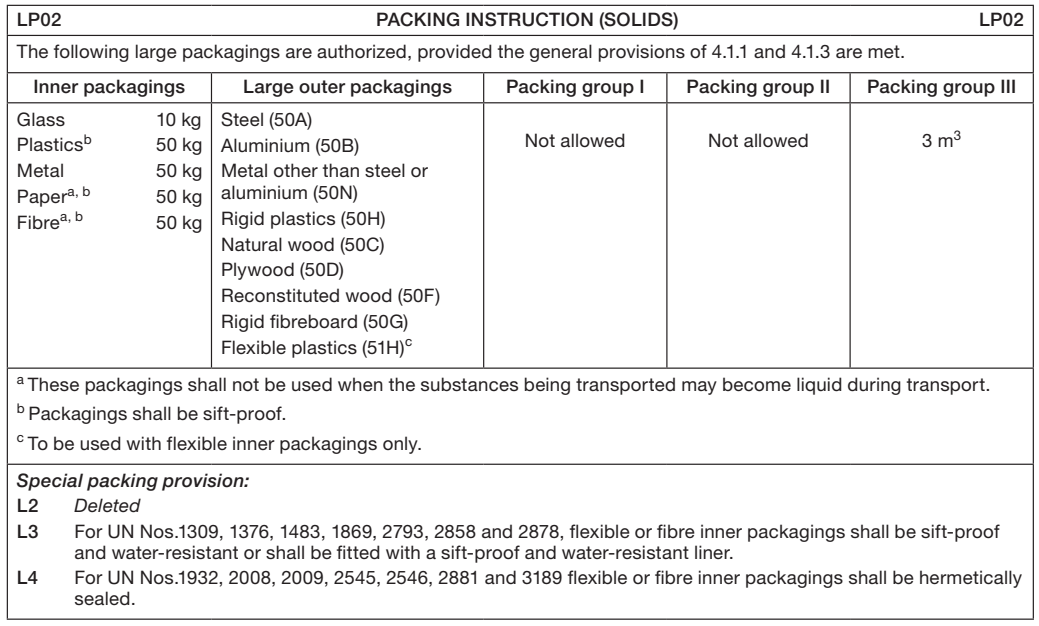
LP02

Source pages and references

Check original English pages and footnotes ↗ · official PDF 236–236

The following large packagings are authorized, provided the general provisions of 4.1.1 and 4.1.3 are met.

Use the instruction and packing group assigned to the selected DGL entry. Inner-packaging limits and outer-packaging limits apply together; also check the assigned special packing provisions.

Inner packagings

  • Glass10 kg
  • Plasticsb50 kg
  • Metal50 kg
  • Paperab50 kg
  • Fibreab50 kg
Large outer packagingsPacking group limits · shared cells in the original table
Packaging type / codePacking group IPacking group IIPacking group III
Steel50A Not allowedNot allowed3 m³
Aluminium50B Not allowedNot allowed3 m³
Metal other than steel or aluminium50N Not allowedNot allowed3 m³
Rigid plastics50H Not allowedNot allowed3 m³
Natural wood50C Not allowedNot allowed3 m³
Plywood50D Not allowedNot allowed3 m³
Reconstituted wood50F Not allowedNot allowed3 m³
Rigid fibreboard50G Not allowedNot allowed3 m³
Flexible plasticsc51H Not allowedNot allowed3 m³

Footnotes · conditions and restrictions

a
These packagings shall not be used when the substances being transported may become liquid during transport.
b
Packagings shall be sift-proof.
c
To be used with flexible inner packagings only.
Special packing provisions in this instruction · 3

Only the provisions assigned to the selected DGL entry apply.

L2 Deleted

L3 For UN Nos.1309, 1376, 1483, 1869, 2793, 2858 and 2878, flexible or fibre inner packagings shall be sift-proof and water-resistant or shall be fitted with a sift-proof and water-resistant liner.

L4 For UN Nos.1932, 2008, 2009, 2545, 2546, 2881 and 3189 flexible or fibre inner packagings shall be hermetically sealed.

IMDG 42-24 · Source PDF pages:240

Check the original table and continuation pages

Original table and continuation pages. Read the applicable packing group, footnotes and assigned special provisions together. Open an image to zoom.

LP02 · English · PDF 240
LP02 · 42-24 · PDF 240 · 1/1
Extracted source text
(SOLIDS) LP02 The following large packagings are authorized, provided the general provisions of 4.1.1 and 4.1.3 are met. Inner packagings Large outer packagings Packing group I Packing group II Packing group III 4 Glass 10 kg Steel (50A) Plasticsb 50 kg Aluminium (50B) Not allowed Not allowed 3 m3 Metal 50 kg Metal other than steel or Papera, b 50 kg aluminium (50N) Fibrea, b 50 kg Rigid plastics (50H) Natural wood (50C) Plywood (50D) Reconstituted wood (50F) Rigid fibreboard (50G) Flexible plastics (51H)c a These packagings shall not be used when the substances being transported may become liquid during transport. b Packagings shall be sift-proof. c To be used with flexible inner packagings only. Special packing provision: L2 Deleted L3 For UN Nos.1309, 1376, 1483, 1869, 2793, 2858 and 2878, flexible or fibre inner packagings shall be sift-proof and water-resistant or shall be fitted with a sift-proof and water-resistant liner. L4 For UN Nos.1932, 2008, 2009, 2545, 2546, 2881 and 3189 flexible or fibre inner packagings shall be hermetically sealed.

IMDG Code 42-24 · English source text

Special packing provisions

PP20

Applies under P003

Source pages and references

Check original English pages and footnotes ↗ · official PDF 169–169

For UN Nos. 1363, 1386, 1408 and 2793, any sift-proof, tearproof receptacle may be used.

IMDG Code 42-24 · English source text

IBC instructions

IBC08

Source pages and references

Check original English pages and footnotes ↗ · official PDF 232–232

IBC08 The following IBCs are authorized, provided the general provisions of 4.1.1, 4.1.2 and 4.1.3 are met: Metal (11A, 11B, 11N, 21A, 21B, 21N, 31A, 31B and 31N); Rigid plastics (11H1, 11H2, 21H1, 21H2, 31H1 and 31H2); Composite (11HZ1, 11HZ2, 21HZ1, 21HZ2 and 31HZ1); Fibreboard (11G); Wooden (11C, 11D and 11F); Flexible (13H1, 13H2, 13H3, 13H4, 13H5, 13L1, 13L2, 13L3, 13L4, 13M1 or 13M2). Additional provisions: Where the solid may become liquid during transport see 4.1.3.4. Special packing provisions: B3 Flexible IBCs shall be sift-proof and water-resistant or shall be fitted with a sift-proof and water-resistant liner. B4 Flexible, fibreboard or wooden IBCs shall be sift-proof and water-resistant or shall be fitted with a sift-proof and water-resistant liner. B6 For UN Nos. 1327, 1363, 1364, 1365, 1386, 1408, 1841, 2211, 2217, 2793 and 3314, IBCs are not required to meet the IBC testing provisions of chapter 6.5. B21 For solid substances in IBCs other than metal or rigid plastics IBCs, the IBCs shall be carried in closed cargo transport units or in freight containers/vehicles, which shall have rigid sides or fences at least to the height of the IBC.

IMDG Code 42-24 · English source text

IBC special provisions

B3

Applies under IBC08

Source pages and references

Check original English pages and footnotes ↗ · official PDF 232–232

Flexible IBCs shall be sift-proof and water-resistant or shall be fitted with a sift-proof and water-resistant liner.

IMDG Code 42-24 · English source text

B6

Applies under IBC08

Source pages and references

Check original English pages and footnotes ↗ · official PDF 232–232

For UN Nos. 1327, 1363, 1364, 1365, 1386, 1408, 1841, 2211, 2217, 2793 and 3314, IBCs are not required to meet the IBC testing provisions of chapter 6.5.

IMDG Code 42-24 · English source text

Special provisions

SP 29

Source pages and references

Check original English pages and footnotes ↗ · official PDF 753–753

The packages, including bales, are exempt from labelling provided that they are marked with the appropriate class (e.g. “class 4.2”).

IMDG Code 42-24 · English source text

SP 929

Source pages and references

Check original English pages and footnotes ↗ · official PDF 781–781

If satisfied, as a result of tests, that such relaxation is justified, the competent authority may permit: – t he seed cakes described as “SEED CAKE, containing vegetable oil (a) mechanically expelled seeds, containing more than 10% of oil or more than 20% of oil and moisture combined” to be transported under conditions governing “SEED CAKE, containing vegetable oil (b) solvent extractions and expelled seeds, containing not more than 10% of oil and, when the amount of moisture is higher than 10% not more than 20% of oil and moisture combined”, and – t he seed cakes described as “SEED CAKE, containing vegetable oil (b) solvent extractions and expelled seeds, containing not more than 10% of oil and, when the amount of moisture is higher than 10% not more than 20% of oil and moisture combined” to be transported under conditions governing SEED CAKE, UN 2217. Certificates from the shipper shall state oil content and moisture content and shall accompany the shipment.

IMDG Code 42-24 · English source text

SP 973

Source pages and references

Check original English pages and footnotes ↗ · official PDF 783–783

Packages, with the exception of bales, shall also display the proper shipping name and the UN number of the substance that they contain in accordance with 5.2.1. In any case, the packages, including bales, are exempt from class marking provided that they are loaded in a cargo transport unit and that they contain goods to which only one UN number has been assigned. The cargo transport units in which the packages, including bales, are loaded shall display any relevant labels, placards and marks in accordance with chapter 5.3.

IMDG Code 42-24 · English source text

Stowage and handling codes

Handling provisions

Bulk containers · BK codes

BK codes describe bulk containers, separately from portable-tank T instructions. A listed code alone does not establish acceptance for sea transport. Check the applicable DGL entry, chapter 4.3 and container requirements in chapter 6.9.

4.3.2.1 · Applicable additional provision

4.3.2.1 Bulk goods of class 4.2 Only closed bulk containers (BK2) may be used. The total mass carried in a bulk container shall be such that its spontaneous ignition temperature is greater than 55°C.

42-24 · Source PDF pages 275

General bulk-container provisions · 4.3.1 (full source text)

Note: Sheeted bulk containers (BK1) shall not be used for sea transport, except as indicated in 4.3.3.

4.3.1.1 This section provides general requirements applicable to the use of containers for the transport of solid substances in bulk. Substances shall be transported in bulk containers conforming to the applicable bulk container instruction identified by the letters BK in column 13 of the Dangerous Goods List, with the following meaning: BK1: the transport in sheeted bulk containers is permitted; BK2: the transport in closed bulk containers is permitted; BK3: the transport in flexible bulk containers is permitted. The bulk container used shall conform to the provisions of chapter 6.9.

42-24 · PDF 274

4.3.1.2 Except as provided in 4.3.1.3, bulk containers shall only be used when a substance is assigned a bulk container code in column 13 of the Dangerous Goods List.

42-24 · PDF 274

4.3.1.3 When a substance is not assigned BK2 or BK3 in column 13 of the Dangerous Goods List, interim approval for transport may be issued by the competent authority of the country of origin. The approval shall be included in the documentation of the consignment and contain, as a minimum, the information normally provided in the bulk container instruction and the conditions under which the substance shall be transported. Appropriate measures should be initiated by the competent authority to have the assignment included in the Dangerous Goods List. When a substance is not permitted in a BK1 bulk container, an exemption may be issued in accordance with 7.9.1.

42-24 · PDF 274

4.3.1.4 Substances which may become liquid at temperatures likely to be encountered during transport are not permitted in bulk containers.

42-24 · PDF 274

4.3.1.5 Bulk containers shall be siftproof and shall be so closed that none of the contents can escape under normal conditions of transport, including the effect of vibration, or by changes of temperature, humidity or pressure.

42-24 · PDF 274

4.3.1.6 Bulk solids shall be loaded into bulk containers and evenly distributed in a manner that minimizes movement that could result in damage to the container or leakage of the dangerous goods.

42-24 · PDF 274

4.3.1.7 Where venting devices are fitted, they shall be kept clear and operable.

42-24 · PDF 274

4.3.1.8 Bulk solids shall not react dangerously with the material of the bulk container, gaskets, equipment including lids and tarpaulins, or with protective coatings which are in contact with the contents, or significantly weaken them. Bulk containers shall be so constructed or adapted that the goods cannot penetrate between wooden floor coverings or come into contact with those parts of the bulk containers that may be affected by the dangerous goods or residues thereof.

42-24 · PDF 274

4.3.1.9 Before being filled and offered for transport, each bulk container shall be inspected and cleaned to ensure that it does not contain any residue on the interior or exterior that could: – cause a dangerous reaction with the substance intended for transport; – detrimentally affect the structural integrity of the bulk container; or – affect the dangerous goods retention capabilities of the bulk container.

42-24 · PDF 274

4.3.1.10 During transport, no dangerous residues shall adhere to the outer surfaces of a bulk container.

42-24 · PDF 274

4.3.1.11 If several closure systems are fitted in series, the system which is located nearest to the dangerous goods to be transported shall be closed first before filling.

42-24 · PDF 274

4.3.1.12 Empty bulk containers that have contained dangerous goods shall be treated in the same manner as is prescribed in this Code for a filled bulk container, unless adequate measures have been taken to nullify any hazard.

42-24 · PDF 274

4.3.1.13 If bulk containers are used for the carriage of bulk goods liable to cause a dust explosion, or evolve flammable vapours (e.g. for certain wastes), measures shall be taken to exclude sources of ignition and to prevent dangerous electrostatic discharge during transport, loading or unloading of the goods.

42-24 · PDF 275

4.3.1.14 Substances, for example wastes, which may react dangerously with one another and substances of different classes and goods not subject to this Code, which are liable to react dangerously with one another, shall not be mixed together in the same bulk container. Dangerous reactions are: .1 combustion and/or evolution of considerable heat; .2 emission of flammable and/or toxic gases; .3 formation of corrosive liquids; or .4 formation of unstable substances.

42-24 · PDF 275

4.3.1.15 Before a bulk container is filled, it shall be visually examined to ensure it is structurally serviceable, its interior walls, ceiling and floors are free from protrusions or damage and that any inner liners or substance retaining equipment are free from rips, tears or any damage that would compromise its cargo retention capabilities. “Structurally serviceable” means the bulk container does not have major defects in its structural components, such as top and bottom side rails, top and bottom end rails, door sill and header, floor cross members, corner posts, and corner fittings in a freight container. Major defects include: .1 bends, cracks or breaks in the structural or supporting members that affect the integrity of the container; .2 more than one splice or an improper splice (such as a lapped splice) in top or bottom end rails or door headers; .3 more than two splices in any one top or bottom side rail; .4 any splice in a door sill or corner post; .5 door hinges and hardware that are seized, twisted, broken, missing, or otherwise inoperative; .6 gaskets and seals that do not seal; .7 any distortion of the overall configuration great enough to prevent proper alignment of handling equipment, mounting and securing chassis or vehicle, or insertion into ships’ cargo spaces; .8 any damage to lifting attachments or handling equipment interface features; or .9 any damage to service or operational equipment.

42-24 · PDF 275

4.3.1.16 Before a flexible bulk container is filled it shall be visually examined to ensure it is structurally serviceable, its textile slings, load-bearing structure straps, body fabric, lock device parts including metal and textile parts are free from protrusions or damage and that inner liners are free from rips, tears or any damage.

42-24 · PDF 275

4.3.1.16.1 For flexible bulk containers, the period of use permitted for the transport of dangerous goods shall be two years from the date of manufacture of the flexible bulk container.

42-24 · PDF 275

4.3.1.16.2 A venting device shall be fitted if a dangerous accumulation of gases may develop within the flexible bulk container. The vent shall be so designed that the penetration of foreign substances or the ingress of water is prevented under normal conditions of transport.

42-24 · PDF 275
Labels and marks

Reference preview for Entry 1 · Packing group III. Other entries may have different subsidiary risks or quantity limits; check their individual fields above. Confirm the cargo classification and any conditions in the special provisions.

Spontaneously combustible 4.2

Explore this class