These portable tank instructions apply to liquid and solid substances of class 1 and classes 3 to 9. The general provisions of section 4.2.1 and the requirements of section 6.7.2 shall be met. The instructions for portable tanks with FRP shells apply to substances of classes or divisions 1, 3, 5.1, 6.1, 6.2, 8 and 9. Additionally, the provisions of chapter 6.10 apply to the portable tanks with FRP shells.
T5 · Selected instruction · IMDG 42-24
Portable tank instruction
Minimum test pressure (bar)
Minimum shell thickness (in mm – reference steel) (see 6.7.2.4)
Pressure relief provisionsa (see 6.7.2.8)
Bottom opening provisionsb (see 6.7.2.6)
T5
2.65
See 6.7.2.4.2
See 6.7.2.8.3
Not allowed
a When the word “Normal” is indicated, all the provisions of 6.7.2.8 apply except for 6.7.2.8.3.
b When this column indicates “not allowed”, bottom openings are not permitted when the substance to be transported
is a liquid (see 6.7.2.6.1). When the substance to be transported is a solid at all temperatures encountered under normal
conditions of transport, bottom openings conforming to the provisions of 6.7.2.6.2 are authorized.
Source PDF pages:264 · 42-24
Extracted source text
S T1 – T22 These portable tank instructions apply to liquid and solid substances of class 1 and classes 3 to 9. The general provisions of section 4.2.1 and the requirements of section 6.7.2 shall be met. The instructions for portable tanks with FRP shells apply to substances of classes or divisions 1, 3, 5.1, 6.1, 6.2, 8 and 9. Additionally, the provisions of chapter 6.10 apply to the portable tanks with FRP shells. Minimum shell thickness Pressure relief Bottom opening (in mm – reference provisionsa provisionsb instruction pressure (bar) steel) (see 6.7.2.8) (see 6.7.2.6) (see 6.7.2.4) 2.65 See 6.7.2.4.2 See 6.7.2.8.3 Not allowed
Where a radioactive material has (a) subsidiary hazard(s):.1 The substance shall be allocated to packing group I, II or III, if appropriate, by application of the packing group criteria provided in part 2 corresponding to the nature of the predominant subsidiary hazard;.2 Packages shall be labelled with subsidiary hazard labels corresponding to each subsidiary hazard exhibited by the material; corresponding placards shall be affixed to cargo transport units in accordance with the relevant provisions of 5.3.1;.3 For the purposes of documentation and package marking, the proper shipping name shall be supplemented with the name of the constituents which most predominantly contribute to this (these) subsidiary hazard(s) and which shall be enclosed in parenthesis;.4 The dangerous goods transport document shall indicate the class or division of the subsidiary hazard and, where assigned, the packing group as required by 5.4.1.4.1.4 and 5.4.1.4.1.5. For packing, see also 4.1.9.1.5.
In the case of non-fissile or fissile-excepted uranium hexafluoride, the material shall be classified under UN 2978.
IMDG Code 42-24 · English source text
Labels and marks
Reference preview for Entry 1. Confirm the cargo classification and any conditions in the special provisions.
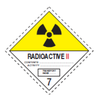
Radioactive II 7B
Subsidiary hazards pending (SP172): this label preview is incomplete; confirm the actual consignment and referenced requirements before completing subsidiary labels.