English proper shipping name · 2 DGL entries — select the applicable conditions below.
Choose the applicable DGL entry
Viewing entry 1
Match the proper shipping name, concentration or form, and packing group to your cargo. All requirements and the label preview below follow the selected entry.
The initial selection is a reference entry, not a classification decision for your cargo. “—” means the source field is not listed.
Class4.2
Packing groupII
EmSF-A, S-J
Dangerous Goods List entries
The comparison below lists all entries. Expanded provisions and the label preview on this page apply to Entry 1.
P402 The following packagings are authorized, provided that the general provisions of 4.1.1 and 4.1.3 are met: (1) Pressure receptacles, provided that the general provisions of 4.1.3.6 are met. They shall be made of steel and subjected to an initial test and periodic tests every 10 years at a pressure of not less than 0.6 MPa (6 bar, gauge pressure). During carriage, the liquid shall be under a layer of inert gas with a gauge pressure of not less than kPa (0.2 bar). (2) Combination packagings Outer packagings: Drums (1A1, 1A2, 1B1, 1B2, 1N1, 1N2, 1H1, 1H2, 1D, 1G); Boxes (4A, 4B, 4N, 4C1, 4C2, 4D, 4F, 4G, 4H1, 4H2); Jerricans (3A1, 3A2, 3B1, 3B2, 3H1, 3H2). Inner packagings with a maximum net mass as follows: Glass 10 kg Metal or plastics 15 kg Each inner packaging shall be fitted with threaded closures. Each inner packaging shall be surrounded by inert cushioning and absorbent material in a quantity sufficient to absorb the entire contents. The maximum net mass per outer packaging shall not exceed 125 kg. (3) Steel drums (1A1) with a maximum capacity of 250 L. (4) Composite packagings consisting of plastics receptacle in a steel or aluminium drum (6HA1 or 6HB1) with a maximum capacity of 250 L. Special packing provision: PP31 For UN Nos. 1389, 1391, 1392, 1420, 1421, 1422, 3148, 3184 (PG II), 3185 (PG II), 3187 (PG II), 3188 (PG II), 3398 (PG I), 3399 (PG I) and 3482, packagings shall be hermetically sealed.
IBC02 The following IBCs are authorized, provided the general provisions of 4.1.1, 4.1.2 and 4.1.3 are met: Metal (31A, 31B and 31N); Rigid plastics (31H1 and 31H2); Composite (31HZ1). Special packing provisions: B5 For UN Nos. 1791, 2014, 2984 and 3149, IBCs shall be provided with a device to allow venting during transport. The inlet to the venting device shall be sited in the vapour space of the IBC under maximum filling conditions during transport. B8 The pure form of this substance shall not be transported in IBCs since it is known to have a vapour pressure of more than 110 kPa at 50C or 130 kPa at 55C. ° ° B15 For UN 2031 with more than 55% nitric acid, the permitted use of rigid plastics IBCs and of rigid plastics inner receptacles of composite IBCs shall be two years from their date of manufacture. B16 For UN 3375, IBCs of type 31A and 31N are not allowed without competent authority approval. B20 For UN Nos. 1716, 1717, 1736, 1737, 1738, 1742, 1743, 1755, 1764, 1768, 1776, 1778, 1782, 1789, 1790, 1796, 1826, 1830, 1832, 2031, 2308, 2353, 2513, 2584, 2796 and 2817 coming under PG II, IBCs shall be fitted with two shut-off devices.
For the purposes of documentation and package marking, the proper shipping name shall be supplemented with the technical name (see 3.1.2.8.1). For UN 3077 and UN 3082 only, the technical name may be a name shown in capital letters in column 2 of the Dangerous Goods List, provided that this name does not include “N.O.S.” and that special provision 274 is not assigned. The name which most appropriately describes the substance or mixture shall be used, e.g.: UN 3082, ENVIRONMENTALLY HAZARDOUS SUBSTANCE, LIQUID, N.O.S. (PAINT) UN 3082, ENVIRONMENTALLY HAZARDOUS SUBSTANCE, LIQUID, N.O.S. (PERFUMERY PRODUCTS).
IMDG Code 42-24 · English source text
Labels and marks
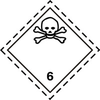
Reference preview for Entry 1 · Packing group II. Other entries may have different subsidiary risks or quantity limits; check their individual fields above. Confirm the cargo classification and any conditions in the special provisions.
Spontaneously combustible 4.2Toxic substance 6.1
⚠ The marine pollutant (MP) status must be determined from the actual consignment: this is a generic N.O.S. entry, and no "P" in column 4 of the Index does not exclude applicability (2.10.2.4). Per 2.10.2.5, if the consignment meets the marine pollutant criteria of 2.9.3 it must be carried as a marine pollutant with the MP mark.
This UN may be carried as an excepted quantity (code E2); if this consignment is shipped as EQ, the EQ mark must be applied and chapter 3.5 complied with