IMDG Code 42-24 · Dangerous Goods List

Open interactive lookup ↗

UN3230SELF-REACTIVE SOLID TYPE F

English proper shipping name · Check the cargo and applicable provisions before shipment.

Class4.1
Packing groupNot assigned in this entry
EmSF-J, S-G

Dangerous Goods List entries

The comparison below lists all entries. Expanded provisions and the label preview on this page apply to Entry 1.

Compare all 1 DGL entry

Entry 1

SELF-REACTIVE SOLID TYPE F

Class
4.1
Subsidiary risk / reference
Not listed
Packing group
Not assigned in this entry
Marine pollutant entry
Not listed; check the cargo classification
Limited quantities
500 g
Excepted quantities
E0
Packing instruction
P520
Special provisions
274
Special packing provision
Not listed
IBC instruction
IBC99
IBC special provisions
Not listed
Portable tank / bulk container codes
T23
Tank special provisions
Not listed
EmS
F-J, S-G
Stowage and handling
Category D SW1 Category D SW1
Segregation
SG35 SG36
Properties and observations · source text
Decomposes at elevated temperatures or in a fire. Burns vigorously. Insoluble in water. Contact with alkalis or acids may cause dangerous decomposition. The products of combustion or self-accelerating decomposition may be toxic by inhalation.

Packing and large packaging instructions

P520

Source pages and references

Check original English pages and footnotes ↗ · official PDF 212–213

P520 This instruction applies to organic peroxides of class 5.2 and self-reactive substances of class 4.1. The packagings listed below are authorized provided the general provisions of 4.1.1 and 4.1.3 and special provisions of 4.1.7 are met. The packing methods are designated OP1 to OP8. The packing methods appropriate for the individual currently assigned organic peroxides and self-reactive substances are listed in 2.4.2.3.2.3 and 2.5.3.2.4. The quantities specified for each packing method are the maximum quantities authorized per package. The following packagings are authorized: (1) Combination packagings with outer packagings comprising boxes (4A, 4B, 4N, 4C1, 4C2, 4D, 4F, 4G, 4H1 and 4H2), drums (1A1, 1A2, 1B1, 1B2, 1G, 1H1, 1H2 and 1D) and jerricans (3A1, 3A2, 3B1, 3B2, 3H1 and 3H2); (2) Single packagings consisting of drums (1A1, 1A2, 1B1, 1B2, 1G, 1H1, 1H2 and 1D) and jerricans (3A1, 3A2, 3B1, 3B2, 3H1 and 3H2); (3) Composite packagings with plastics inner receptacles (6HA1, 6HA2, 6HB1, 6HB2, 6HC, 6HD1, 6HD2, 6HG1, 6HG2, 6HH1 and 6HH2). The maximum quantities per packaging/package for packing methods OP1 to OP8 are: OP1 OP21 OP3 OP41 OP5 OP6 OP7 OP8 Maximum net mass (kg) for solids and for 0.5 0.5/10 5 5/25 25 50 50 4002 combination packagings (liquid and solid) Maximum contents in litres for liquids3 0.5 – 5 – 30 60 60 2254 If two values are given, the first applies to the maximum net mass per inner packaging and the second to the maximum net mass of the complete package. 60 kg for jerricans/200 kg for boxes and, for solids, 400 kg in combination packagings with outer packagings comprising boxes (4C1, 4C2, 4D, 4F, 4G, 4H1 and 4H2) and with inner packagings of plastics or fibre with a maximum net mass of 25 kg. Viscous liquids shall be treated as solids when they do not meet the criteria provided in the definition for liquids presented in 1.2.1. 60 L for jerricans. Additional provisions: Metal packagings, including inner packagings of combination packagings and outer packagings of combination or composite packagings, may only be used for packing methods OP7 and OP8. 4 In combination packagings, glass receptacles may only be used as inner packagings with a maximum content of 0.5 kg for solids or 0.5 L for liquids. In combination packagings, cushioning materials shall not be readily combustible. The packaging of an organic peroxide or self-reactive substance required to bear an EXPLOSIVE subsidiary hazard label (Model No. 1, see 5.2.2.2.2) shall also comply with the provisions given in 4.1.5.10 and 4.1.5.11. (continued) P520 Special packing provisions: PP21 For certain self-reactive substances of types B or C, UN Nos. 3221, 3222, 3223, 3224, 3231, 3232, 3233 and 3234, a smaller packaging than that allowed by packing methods OP5 or OP6 respectively shall be used (see 4.1.7 and 2.4.2.3.2.3). PP22 UN 3241, 2-bromo-2-nitropropane-1,3-diol, shall be packed in accordance with packing method OP6. PP94 Very small amounts of energetic samples of section 2.0.4.3 may be carried under UN 3223 or UN 3224, as appropriate, provided that:.1 only combination packaging with outer packaging comprising boxes (4A, 4B, 4N, 4C1, 4C2, 4D, 4F, 4G, 4H1 and 4H2) are used;.2 the samples are carried in microtiter plates or multi-titer plates made of plastics, glass, porcelain or stoneware as inner packaging;.3 the maximum amount per individual inner cavity does not exceed 0.01 g for solids or 0.01 mL for liquids;.4 the maximum net quantity per outer packaging is 20 g for solids or 20 mL for liquids, or in the case of mixed packing the sum of grams and millilitres does not exceed 20; and.5 when dry ice or liquid nitrogen is optionally used as a coolant for quality control measures, the requirements of 5.5.3 are complied with. Interior supports shall be provided to secure the inner packagings in their original position. The inner and outer packagings shall maintain their integrity at the temperature of the refrigerant used as well as the temperatures and the pressures which could result if refrigeration were lost. PP95 Small amounts of energetic samples of section 2.0.4.3 may be carried under UN 3223 or UN 3224, as appropriate, provided that:.1 the outer packaging consist only of corrugated fibreboard of type 4G having minimum dimensions of 60 cm (length) by 40.5 cm (width) by 30 cm (height) and minimum wall thickness of 1.3 cm;.2 the individual substance is contained in an inner packaging of glass or plastics of maximum capacity mL placed in an expandable polyethylene foam matrix of at least 130 mm thickness having a density of 18 1 g/L; ±.3 within the foam carrier, inner packagings are segregated from each other by a minimum distance of 40 mm and from the wall of the outer packaging by a minimum distance of 70 mm. The package may contain up to two layers of such foam matrices, each carrying up to 28 inner packagings;.4 the maximum content of each inner packaging does not exceed 1 g for solids or 1 mL for liquids;.5 the maximum net quantity per outer packaging is 56 g for solids or 56 mL for liquids, or in the case of mixed packing the sum of grams and millilitres does not exceed 56; and.6 when dry ice or liquid nitrogen is optionally used as a coolant for quality control measures, the requirements of 5.5.3 are complied with. Interior supports shall be provided to secure the inner packagings in their original position. The inner and outer packagings shall maintain their integrity at the temperature of the refrigerant used as well as the temperatures and the pressures which could result if refrigeration were lost.

IMDG Code 42-24 · English source text
IBC instructions

IBC99

Source pages and references

Check original English pages and footnotes ↗ · official PDF 232–232

IBC99 Only IBCs which are approved for these goods by the competent authority may be used (see 4.1.3.7). A copy of the competent authority approval shall accompany each consignment or the transport document shall include an indication that the packaging was approved by the competent authority.

IMDG Code 42-24 · English source text
Portable tank instructions

T23

Source pages and references

Check original English pages and footnotes ↗ · official PDF 261–262

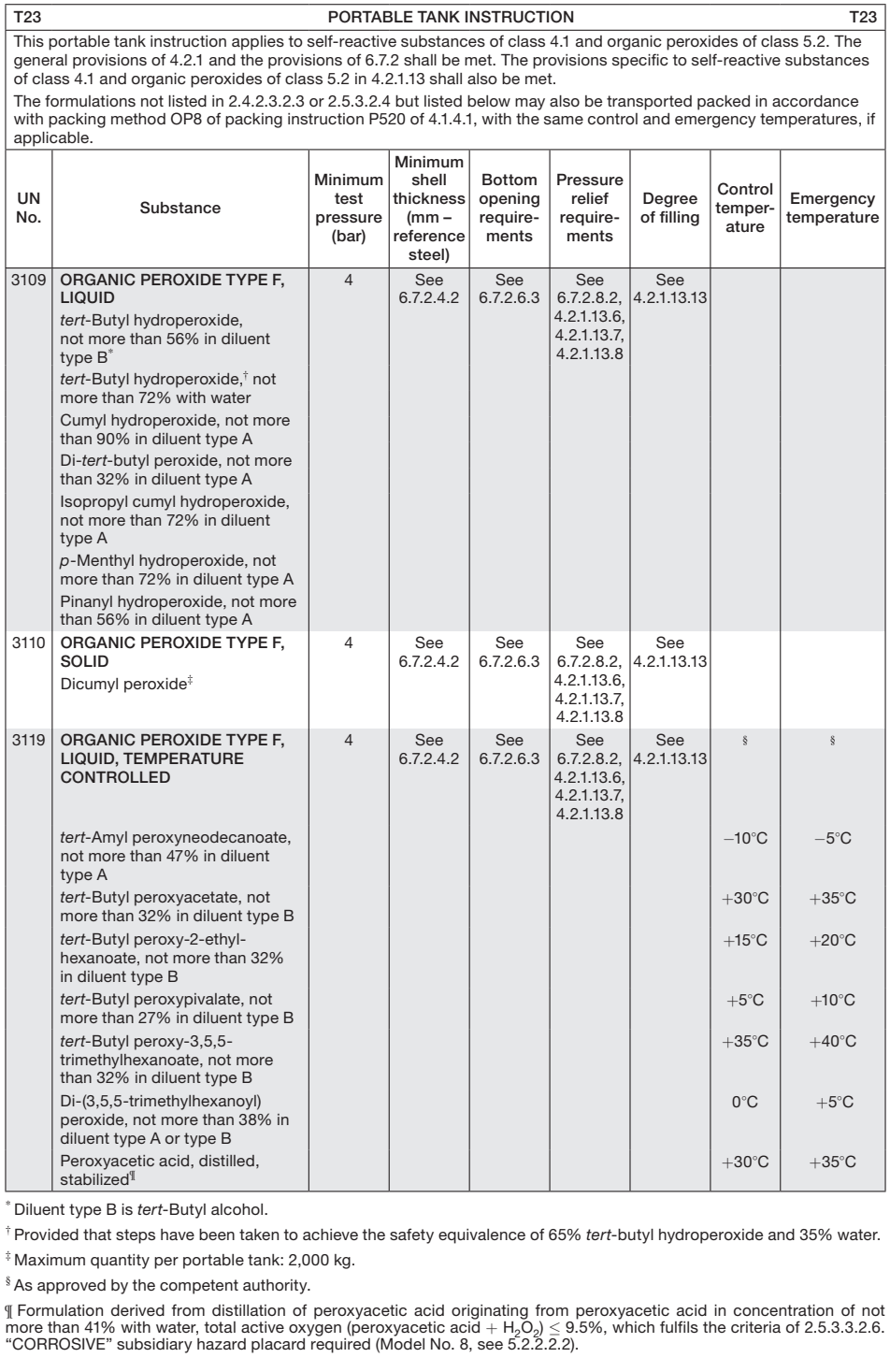
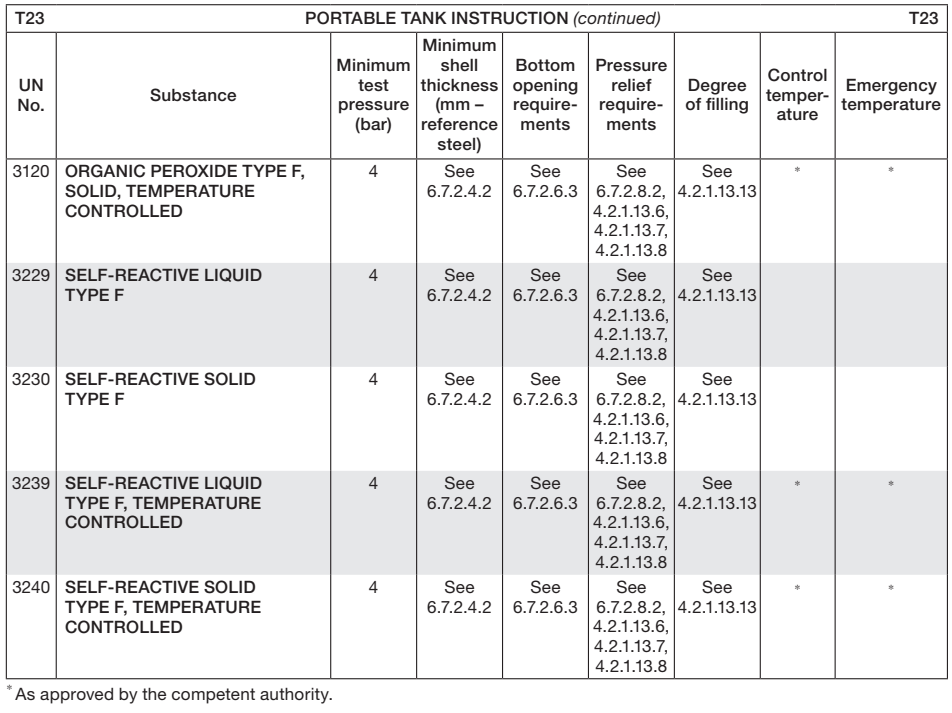
This portable tank instruction applies to self-reactive substances of class 4.1 and organic peroxides of class 5.2. The general provisions of 4.2.1 and the provisions of 6.7.2 shall be met. The provisions specific to self-reactive substances of class 4.1 and organic peroxides of class 5.2 in 4.2.1.13 shall also be met. The formulations not listed in 2.4.2.3.2.3 or 2.5.3.2.4 but listed below may also be transported packed in accordance with packing method OP8 of packing instruction P520 of 4.1.4.1, with the same control and emergency temperatures, if applicable.

Showing all source rows for UN3230. Match the exact gas or formulation and the assigned TP provisions. A UN number alone does not establish suitability of the tank or approval of the consignment.

SELF-REACTIVE SOLID TYPE F

Minimum test pressure (bar)
4
Minimum shell thickness (mm – reference steel)
See 6.7.2.4.2
Bottom opening requirements
See 6.7.2.6.3
Pressure relief requirements
See 6.7.2.8.2, 4.2.1.13.6, 4.2.1.13.7, 4.2.1.13.8
Degree of filling
See 4.2.1.13.13
Source formulations and temperature entries
Substance / formulationControl temperatureEmergency temperature
SELF-REACTIVE SOLID TYPE F——

— represents a blank source cell, not zero or an exemption. Symbols requiring competent-authority approval are retained; the temperatures depend on the exact formulation and concentration.

Footnotes · conditions and exceptions

*
Diluent type B is tert-Butyl alcohol.PDF 265
†
Provided that steps have been taken to achieve the safety equivalence of 65% tert-butyl hydroperoxide and 35% water.PDF 265
‡
Maximum quantity per portable tank: 2,000 kg.PDF 265
§
As approved by the competent authority.PDF 265
Formulation derived from distillation of peroxyacetic acid originating from peroxyacetic acid in concentration of not more than 41% with water, total active oxygen (peroxyacetic acid + H2O2) ≤ 9.5%, which fulfils the criteria of 2.5.3.3.2.6. “CORROSIVE” subsidiary hazard placard required (Model No. 8, see 5.2.2.2.2).PDF 265
*
As approved by the competent authority.PDF 266
Referenced requirements and original formula pages

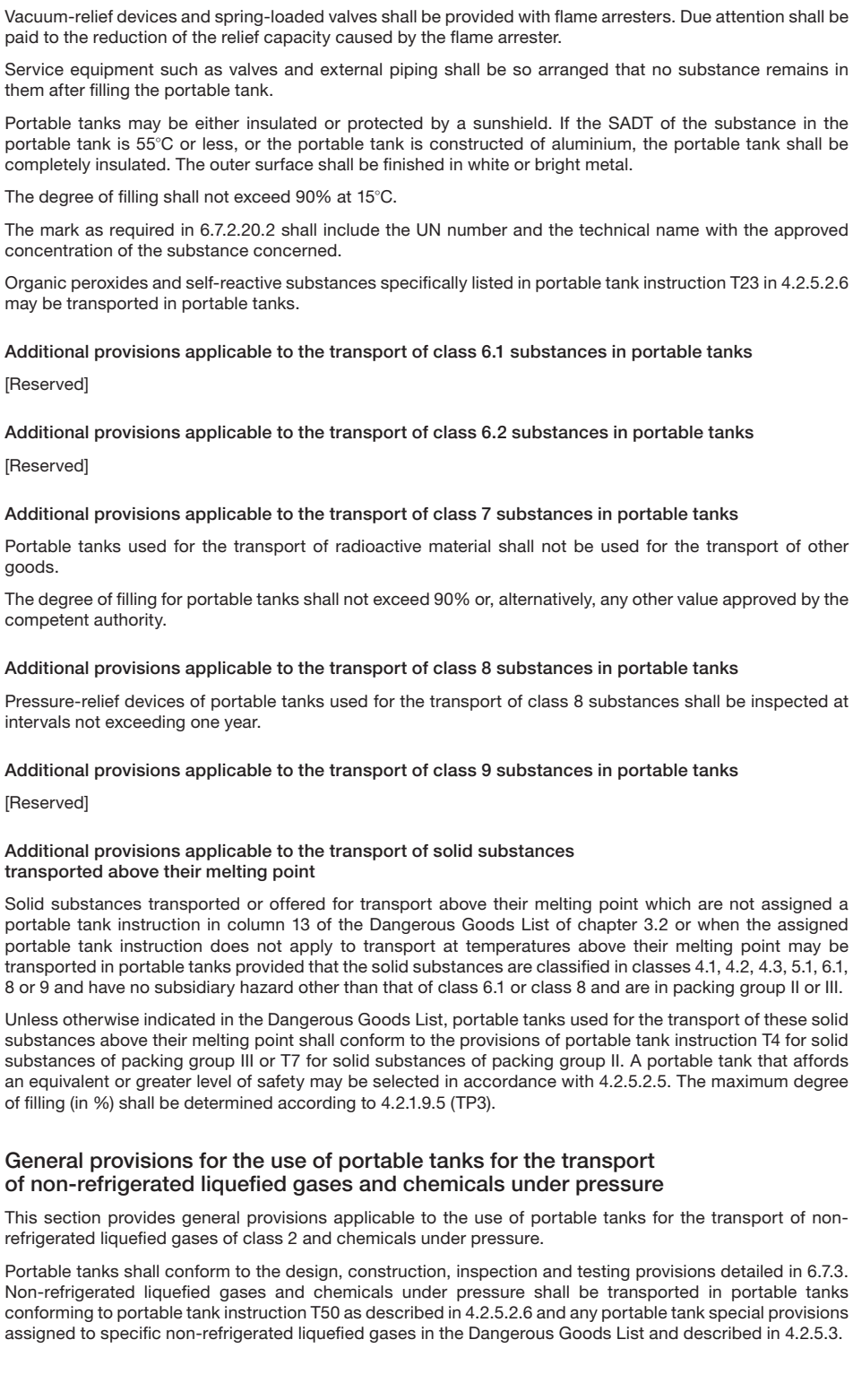
The formula in 4.2.1.13.8 is provided in the original pages below; it has not been converted into a calculator or flattened text formula.

4.2.1.13.1

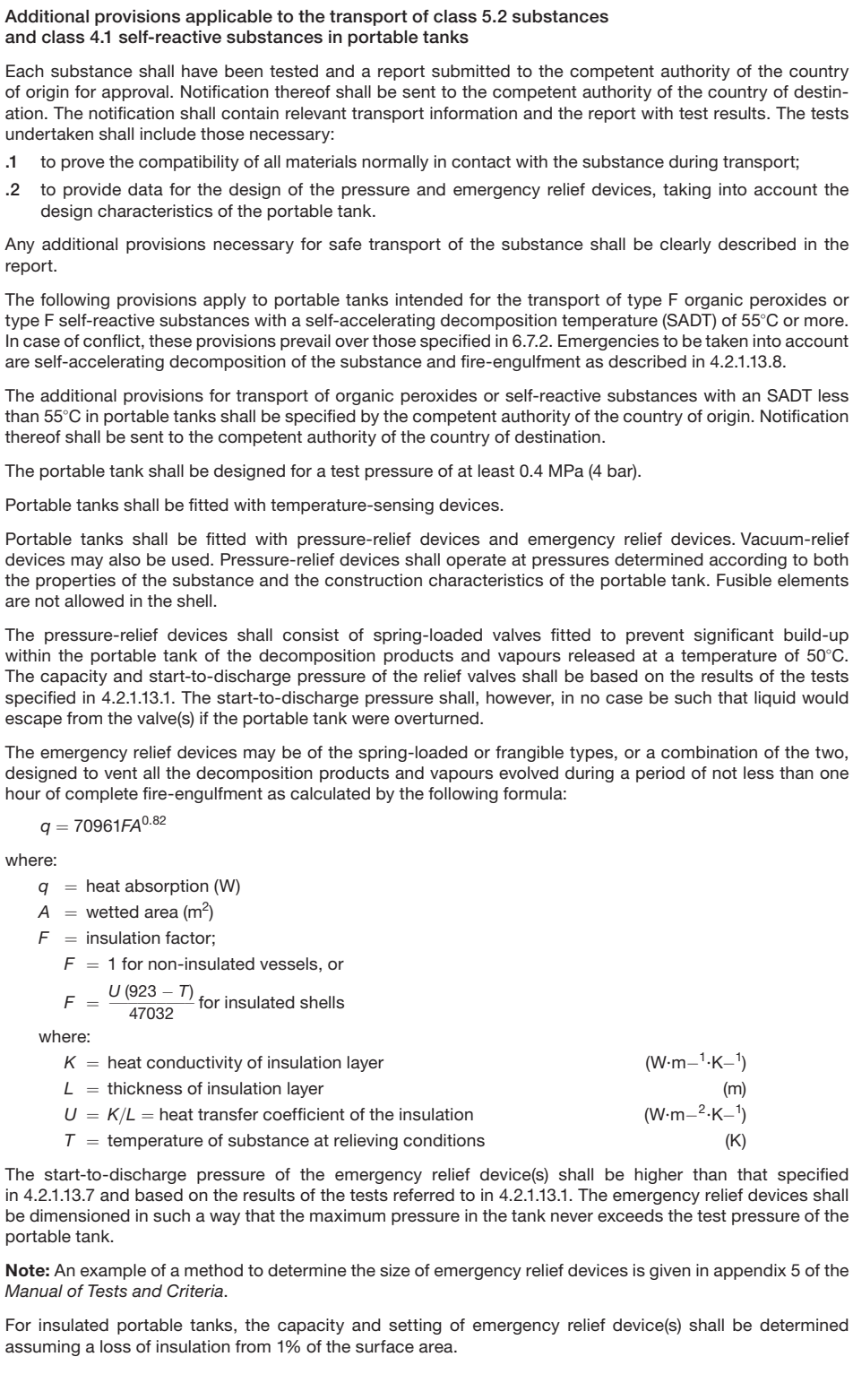
Each substance shall have been tested and a report submitted to the competent authority of the country of origin for approval. Notification thereof shall be sent to the competent authority of the country of destination. The notification shall contain relevant transport information and the report with test results. The tests undertaken shall include those necessary: .1 to prove the compatibility of all materials normally in contact with the substance during transport; .2 to provide data for the design of the pressure and emergency relief devices, taking into account the design characteristics of the portable tank. Any additional provisions necessary for safe transport of the substance shall be clearly described in the report.

PDF 258, 259

4.2.1.13.2

The following provisions apply to portable tanks intended for the transport of type F organic peroxides or type F self-reactive substances with a self-accelerating decomposition temperature (SADT) of 55°C or more. In case of conflict, these provisions prevail over those specified in 6.7.2. Emergencies to be taken into account are self-accelerating decomposition of the substance and fire-engulfment as described in 4.2.1.13.8.

PDF 258, 259

4.2.1.13.3

The additional provisions for transport of organic peroxides or self-reactive substances with an SADT less than 55°C in portable tanks shall be specified by the competent authority of the country of origin. Notification thereof shall be sent to the competent authority of the country of destination.

PDF 258, 259

4.2.1.13.4

The portable tank shall be designed for a test pressure of at least 0.4 MPa (4 bar).

PDF 258, 259

4.2.1.13.5

Portable tanks shall be fitted with temperature-sensing devices.

PDF 258, 259

4.2.1.13.6

Portable tanks shall be fitted with pressure-relief devices and emergency relief devices. Vacuum-relief devices may also be used. Pressure-relief devices shall operate at pressures determined according to both the properties of the substance and the construction characteristics of the portable tank. Fusible elements are not allowed in the shell.

PDF 258, 259

4.2.1.13.7

The pressure-relief devices shall consist of spring-loaded valves fitted to prevent significant build-up within the portable tank of the decomposition products and vapours released at a temperature of 50°C. The capacity and start-to-discharge pressure of the relief valves shall be based on the results of the tests specified in 4.2.1.13.1. The start-to-discharge pressure shall, however, in no case be such that liquid would escape from the valve(s) if the portable tank were overturned.

PDF 258, 259

4.2.1.13.9

For insulated portable tanks, the capacity and setting of emergency relief device(s) shall be determined assuming a loss of insulation from 1% of the surface area.

PDF 258, 259

4.2.1.13.10

Vacuum-relief devices and spring-loaded valves shall be provided with flame arresters. Due attention shall be paid to the reduction of the relief capacity caused by the flame arrester.

PDF 258, 259

4.2.1.13.11

Service equipment such as valves and external piping shall be so arranged that no substance remains in them after filling the portable tank.

PDF 258, 259

4.2.1.13.12

Portable tanks may be either insulated or protected by a sunshield. If the SADT of the substance in the portable tank is 55°C or less, or the portable tank is constructed of aluminium, the portable tank shall be completely insulated. The outer surface shall be finished in white or bright metal.

PDF 258, 259

4.2.1.13.13

The degree of filling shall not exceed 90% at 15°C.

PDF 258, 259

4.2.1.13.14

The mark as required in 6.7.2.20.2 shall include the UN number and the technical name with the approved concentration of the substance concerned.

PDF 258, 259

4.2.1.13.15

Organic peroxides and self-reactive substances specifically listed in portable tank instruction T23 in 4.2.5.2.6 may be transported in portable tanks.

PDF 258, 259

T23 · English · PDF 258
T23 · 42-24 · PDF 258 · 1/2
T23 · English · PDF 259
T23 · 42-24 · PDF 259 · 2/2
Original instruction, tables and continuation pages

Original pages are preserved as supplied. The readable display follows the verified English numerical values and references and, for T50, the December 2025 corrigendum. The original pages may therefore show superseded wording or source discrepancies.

T23 · English · PDF 265
T23 · 42-24 · PDF 265 · 1/2
T23 · English · PDF 266
T23 · 42-24 · PDF 266 · 2/2

IMDG 42-24 · Source PDF pages:265, 266 · Checked 2026-10-22

Extracted source text
T23 This portable tank instruction applies to self-reactive substances of class 4.1 and organic peroxides of class 5.2. The general provisions of 4.2.1 and the provisions of 6.7.2 shall be met. The provisions specific to self-reactive substances of class 4.1 and organic peroxides of class 5.2 in 4.2.1.13 shall also be met. The formulations not listed in 2.4.2.3.2.3 or 2.5.3.2.4 but listed below may also be transported packed in accordance with packing method OP8 of packing instruction P520 of 4.1.4.1, with the same control and emergency temperatures, if applicable. Minimum Minimum shell Bottom Pressure Control UN test thickness opening relief Degree Emergency Substance temper- No. pressure (mm – require- require- of filling temperature ature (bar) reference ments ments steel) 3109 ORGANIC PEROXIDE TYPE F, 4 See See See See LIQUID 6.7.2.4.2 6.7.2.6.3 6.7.2.8.2, 4.2.1.13.13 tert-Butyl hydroperoxide, 4.2.1.13.6, not more than 56% in diluent 4.2.1.13.7, type B* 4.2.1.13.8 tert-Butyl hydroperoxide,† not more than 72% with water Cumyl hydroperoxide, not more than 90% in diluent type A Di-tert-butyl peroxide, not more than 32% in diluent type A Isopropyl cumyl hydroperoxide, not more than 72% in diluent type A p-Menthyl hydroperoxide, not more than 72% in diluent type A Pinanyl hydroperoxide, not more than 56% in diluent type A 3110 ORGANIC PEROXIDE TYPE F, 4 See See See See SOLID 6.7.2.4.2 6.7.2.6.3 6.7.2.8.2, 4.2.1.13.13 Dicumyl peroxide‡ 4.2.1.13.6, 4.2.1.13.7, 4.2.1.13.8 3119 ORGANIC PEROXIDE TYPE F, 4 See See See See § § LIQUID, TEMPERATURE 6.7.2.4.2 6.7.2.6.3 6.7.2.8.2, 4.2.1.13.13 CONTROLLED 4.2.1.13.6, 4.2.1.13.7, 4.2.1.13.8 tert-Amyl peroxyneodecan oate, 10C 5C - ° - ° not more than 47% in diluent type A tert-Butyl peroxyacetate, not 30C 35C + ° + ° more than 32% in diluent type B tert-Butyl peroxy-2-ethyl- 15C 20C + ° + ° hexanoate, not more than 32% in diluent type B tert-Butyl peroxypivalate, not 5C 10C + ° + ° more than 27% in diluent type B tert-Butyl peroxy-3,5,5- 35C 40C + ° + ° trimethylhexanoate, not more than 32% in diluent type B Di-(3,5,5-trimethylhexanoyl) 0C 5C ° + ° peroxide, not more than 38% in diluent type A or type B Peroxyacetic acid, distilled, 30C 35C + ° + ° stabilized¶ * Diluent type B is tert-Butyl alcohol. † Provided that steps have been taken to achieve the safety equivalence of 65% tert-butyl hydroperoxide and 35% water. ‡ Maximum quantity per portable tank: 2,000 kg. § As approved by the competent authority. ¶ Formulation derived from distillation of peroxyacetic acid originating from peroxyacetic acid in concentration of not more than 41% with water, total active oxygen (peroxyacetic acid H O) 9.5%, which fulfils the criteria of 2.5.3.3.2.6. + 2 2 ≤ “CORROSIVE” subsidiary hazard placard required (Model No. 8, see 5.2.2.2.2). (continued) T23 Minimum Minimum shell Bottom Pressure Control UN test thickness opening relief Degree Emergency Substance temper- No. pressure (mm – require- require- of filling temperature ature (bar) reference ments ments steel) 3120 ORGANIC PEROXIDE TYPE F, 4 See See See See * * SOLID, TEMPERATURE 6.7.2.4.2 6.7.2.6.3 6.7.2.8.2, 4.2.1.13.13 CONTROLLED 4.2.1.13.6, 4.2.1.13.7, 4.2.1.13.8 3229 SELF-REACTIVE LIQUID 4 See See See See TYPE F 6.7.2.4.2 6.7.2.6.3 6.7.2.8.2, 4.2.1.13.13 4.2.1.13.6, 4.2.1.13.7, 4.2.1.13.8 3230 SELF-REACTIVE SOLID 4 See See See See TYPE F 6.7.2.4.2 6.7.2.6.3 6.7.2.8.2, 4.2.1.13.13 4.2.1.13.6, 4.2.1.13.7, 4.2.1.13.8 3239 SELF-REACTIVE LIQUID 4 See See See See * * TYPE F, TEMPERATURE 6.7.2.4.2 6.7.2.6.3 6.7.2.8.2, 4.2.1.13.13 CONTROLLED 4.2.1.13.6, 4.2.1.13.7, 4.2.1.13.8 3240 SELF-REACTIVE SOLID 4 See See See See * * TYPE F, TEMPERATURE 6.7.2.4.2 6.7.2.6.3 6.7.2.8.2, 4.2.1.13.13 CONTROLLED 4.2.1.13.6, 4.2.1.13.7, 4.2.1.13.8 * As approved by the competent authority.

IMDG Code 42-24 · English source text
Special provisions

SP 274

Source pages and references

Check original English pages and footnotes ↗ · official PDF 761–761

For the purposes of documentation and package marking, the proper shipping name shall be supplemented with the technical name (see 3.1.2.8.1). For UN 3077 and UN 3082 only, the technical name may be a name shown in capital letters in column 2 of the Dangerous Goods List, provided that this name does not include “N.O.S.” and that special provision 274 is not assigned. The name which most appropriately describes the substance or mixture shall be used, e.g.: UN 3082, ENVIRONMENTALLY HAZARDOUS SUBSTANCE, LIQUID, N.O.S. (PAINT) UN 3082, ENVIRONMENTALLY HAZARDOUS SUBSTANCE, LIQUID, N.O.S. (PERFUMERY PRODUCTS).

IMDG Code 42-24 · English source text
Stowage and handling codes

Segregation codes

Labels and marks

Reference preview for Entry 1. Confirm the cargo classification and any conditions in the special provisions.

Flammable solid 4.1
Flammable solid 4.1

This UN may be carried as a limited quantity (Code allocation 500 g); if this consignment is shipped as LQ, the LQ mark must be applied and chapter 3.4 complied with

Explore this class