PHOSPHORUS, WHITE or YELLOW, DRY or UNDER WATER or IN SOLUTION
Class
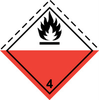
4.2
Subsidiary risk / reference
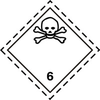
6.1
Packing group
I
Marine pollutant entry
P
Limited quantities
0
Excepted quantities
E0
Packing instruction
P405
Special provisions
Not listed
Special packing provision
PP31
IBC instruction
Not listed
IBC special provisions
Not listed
Portable tank / bulk container codes
T9
Tank special provisions
TP3 TP31
EmS
F-A, S-J
Stowage and handling
Category E Category E
Segregation
Not listed in this DGL field
Properties and observations · source text
Ignites spontaneously in air. Melting point: 44 C. Toxic if swallowed, ° by skin contact or by inhalation. Receptacles are usually filled with substance in the liquid state which subsequently solidifies. A sufficient ullage should be allowed.
P405 This instruction applies to UN 1381. The following packagings are authorized, provided that the general provisions of 4.1.1 and 4.1.3 are met: (1) For UN 1381, wet phosphorus:.1 Combination packagings Outer packagings: Boxes (4A, 4B, 4N, 4C1, 4C2, 4D or 4F); maximum net mass: 75 kg Inner packagings: (i) hermetically sealed metal cans, with a maximum net mass of 15 kg; or (ii) glass inner packagings cushioned on all sides with dry, absorbent, non-combustible material in a quantity sufficient to absorb the entire contents with a maximum net mass of 2 kg; or.2 Drums (1A1, 1A2, 1B1, 1B2, 1N1 or 1N2); maximum net mass: 400 kg Jerricans (3A1 or 3B1); maximum net mass: 120 kg. These packagings shall be capable of passing the leakproofness test specified in 6.1.5.4 at the packing group II performance level. (2) For UN 1381, dry phosphorus:.1 When fused, drums (1A2, 1B2 or 1N2) with a maximum net mass of 400 kg; or.2 In projectiles or hard-cased articles when transported without class 1 components, as specified by the competent authority. Special packing provision: PP31 For UN 1381, packagings shall be hermetically sealed.
These portable tank instructions apply to liquid and solid substances of class 1 and classes 3 to 9. The general provisions of section 4.2.1 and the requirements of section 6.7.2 shall be met. The instructions for portable tanks with FRP shells apply to substances of classes or divisions 1, 3, 5.1, 6.1, 6.2, 8 and 9. Additionally, the provisions of chapter 6.10 apply to the portable tanks with FRP shells.
T9 · Selected instruction · IMDG 42-24
Portable tank instruction
Minimum test pressure (bar)
Minimum shell thickness (in mm – reference steel) (see 6.7.2.4)
Pressure relief provisionsa (see 6.7.2.8)
Bottom opening provisionsb (see 6.7.2.6)
T9
4
6 mm
Normal
Not allowed
a When the word “Normal” is indicated, all the provisions of 6.7.2.8 apply except for 6.7.2.8.3.
b When this column indicates “not allowed”, bottom openings are not permitted when the substance to be transported
is a liquid (see 6.7.2.6.1). When the substance to be transported is a solid at all temperatures encountered under normal
conditions of transport, bottom openings conforming to the provisions of 6.7.2.6.2 are authorized.
Source PDF pages:264 · 42-24
Extracted source text
S T1 – T22 These portable tank instructions apply to liquid and solid substances of class 1 and classes 3 to 9. The general provisions of section 4.2.1 and the requirements of section 6.7.2 shall be met. The instructions for portable tanks with FRP shells apply to substances of classes or divisions 1, 3, 5.1, 6.1, 6.2, 8 and 9. Additionally, the provisions of chapter 6.10 apply to the portable tanks with FRP shells. Minimum shell thickness Pressure relief Bottom opening (in mm – reference provisionsa provisionsb instruction pressure (bar) steel) (see 6.7.2.8) (see 6.7.2.6) (see 6.7.2.4) 4 6 mm Normal Not allowed
The maximum degree of filling (in%) for solids transported above their melting points and for elevated temperature liquids shall be determined in accordance with 4.2.1.9.5.