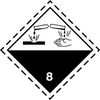
Silvery-white metallic element that melts at 29 C, becoming a ° bright, shiny liquid. Insoluble in water. Highly corrosive to aluminium. Harmful if swallowed, by skin contact or by inhalation. Special care should be taken if a leakage occurs when carried in aluminium freight containers. Carriage should be prohibited in hovercraft and other ships constructed from aluminium.
P800 This instruction applies to UN Nos. 2803 and 2809. The following packagings are authorized, provided the general provisions of 4.1.1 and 4.1.3 are met: (1) Pressure receptacles, provided that the general provisions of 4.1.3.6 are met. (2) Steel flasks or bottles with threaded closures with a capacity not exceeding 3.0 L; or (3) Combination packagings which conform to the following provisions: (a) Inner packagings shall comprise glass, metal or rigid plastics intended to contain liquids with a maximum net mass of 15 kg each. (b) The inner packagings shall be packed with sufficient cushioning material to prevent breakage. (c) Either the inner packagings or the outer packagings shall have inner liners or bags of strong leakproof and puncture-resistant material impervious to the contents and completely surrounding the contents to prevent it from escaping from the package irrespective of its position or orientation. (d) The following outer packagings and maximum net masses are authorized: Outer packaging Maximum net mass Drums steel (1A1, 1A2) 400 kg metal, other than steel or aluminium (1N1, 1N2) 400 kg plastics (1H1, 1H2) 400 kg plywood (1D) 400 kg fibre (1G) 400 kg Boxes steel (4A) 400 kg metal, other than steel or aluminium (4N) 400 kg natural wood (4C1) 250 kg natural wood with sift-proof walls (4C2) 250 kg plywood (4D) 250 kg reconstituted wood (4F) 125 kg fibreboard (4G) 125 kg expanded plastics (4H1) 60 kg solid plastics (4H2) 125 kg Special packing provision: PP41 For UN 2803, when it is necessary to transport gallium at low temperatures in order to maintain it in a completely solid state, the above packagings may be overpacked in a strong, water-resistant outer packaging which contains dry ice or other means of refrigeration. When dry ice or other means of refrigeration presenting a risk of asphyxiation are used as a coolant, the requirements of 5.5.3 shall apply. If a refrigerant is used, all of the above materials used in the packaging of gallium shall be chemically and physically resistant to the refrigerant and shall have impact resistance at the low temperatures of the refrigerant employed. If dry ice is used, the outer packaging shall permit the release of carbon dioxide gas. Interior supports shall be provided to prevent movement after the dissipation of the refrigerant.
For UN 2803, when it is necessary to transport gallium at low temperatures in order to maintain it in a completely solid state, the above packagings may be overpacked in a strong, water-resistant outer packaging which contains dry ice or other means of refrigeration. When dry ice or other means of refrigeration presenting a risk of asphyxiation are used as a coolant, the requirements of 5.5.3 shall apply. If a refrigerant is used, all of the above materials used in the packaging of gallium shall be chemically and physically resistant to the refrigerant and shall have impact resistance at the low temperatures of the refrigerant employed. If dry ice is used, the outer packaging shall permit the release of carbon dioxide gas. Interior supports shall be provided to prevent movement after the dissipation of the refrigerant.
These portable tank instructions apply to liquid and solid substances of class 1 and classes 3 to 9. The general provisions of section 4.2.1 and the requirements of section 6.7.2 shall be met. The instructions for portable tanks with FRP shells apply to substances of classes or divisions 1, 3, 5.1, 6.1, 6.2, 8 and 9. Additionally, the provisions of chapter 6.10 apply to the portable tanks with FRP shells.
T1 · Selected instruction · IMDG 42-24
Portable tank instruction
Minimum test pressure (bar)
Minimum shell thickness (in mm – reference steel) (see 6.7.2.4)
Pressure relief provisionsa (see 6.7.2.8)
Bottom opening provisionsb (see 6.7.2.6)
T1
1.5
See 6.7.2.4.2
Normal
See 6.7.2.6.2
a When the word “Normal” is indicated, all the provisions of 6.7.2.8 apply except for 6.7.2.8.3.
b When this column indicates “not allowed”, bottom openings are not permitted when the substance to be transported
is a liquid (see 6.7.2.6.1). When the substance to be transported is a solid at all temperatures encountered under normal
conditions of transport, bottom openings conforming to the provisions of 6.7.2.6.2 are authorized.
Source PDF pages:264 · 42-24
Extracted source text
S T1 – T22 These portable tank instructions apply to liquid and solid substances of class 1 and classes 3 to 9. The general provisions of section 4.2.1 and the requirements of section 6.7.2 shall be met. The instructions for portable tanks with FRP shells apply to substances of classes or divisions 1, 3, 5.1, 6.1, 6.2, 8 and 9. Additionally, the provisions of chapter 6.10 apply to the portable tanks with FRP shells. Minimum shell thickness Pressure relief Bottom opening (in mm – reference provisionsa provisionsb instruction pressure (bar) steel) (see 6.7.2.8) (see 6.7.2.6) (see 6.7.2.4) 1.5 See 6.7.2.4.2 Normal See 6.7.2.6.2
The portable tank instruction assigned for this substance applies for granular and powdered solids and for solids which are filled and discharged at temperatures above their melting point and which are cooled and transported as a solid mass. For solids which are transported above their melting point, see 4.2.1.19.
Reference preview for Entry 1 · Packing group III. Confirm the cargo classification and any conditions in the special provisions.
Corrosive 8
This UN may be carried as a limited quantity (Code allocation 5 kg); if this consignment is shipped as LQ, the LQ mark must be applied and chapter 3.4 complied with